
Meta Lawsuits and Privacy History: Why Safegram is Better
A deep dive into the legal failures of big tech and why Safegram's Dublin-built, privacy-first model is the necessary future of social networking.
As we navigate the digital landscape of 2026, the conversation around digital rights has been dominated by the compounding weight of Meta lawsuits and privacy history. For two decades, the social media giant has operated under a model of 'move fast and break things,' often at the expense of user data sovereignty and mental health. This systemic failure has created an urgent demand for a new paradigm—one represented by Safegram, a Dublin-built, privacy-first social network. By removing the incentive to exploit user data, Safegram provides a legitimate Instagram alternative that prioritizes human safety over advertising revenue.
TL;DR: Meta Lawsuits and Privacy History
- Massive Litigation: Meta has faced record-breaking fines globally, including the multi-billion euro GDPR penalties and the landmark US settlements regarding data misuse and child safety.
- Data Monetization: The core issue stems from an advertising model that requires invasive tracking and the sale of user behavioral data to third parties.
- Verified Alternative: Safegram solves these issues by having no ads, no data selling, and mandatory identity verification via Didit to eliminate bots and fraud.
- Verified Commerce: Through the Safegram Exchange and Safegram Select, users interact with authenticated businesses rather than anonymous, unvetted profiles.
The Extensive Timeline of Meta Lawsuits and Privacy History
The history of Meta, formerly Facebook, is inextricably linked to a series of legal challenges that have redefined global privacy laws. From the Cambridge Analytica scandal that broke in 2018 to the massive 2023-2025 European Data Protection Board (EDPB) rulings, the company has consistently struggled to align its business model with the right to privacy. These lawsuits are not merely financial hurdles; they are evidence of a fundamental architectural flaw in how data is harvested.
In recent years, the focus of litigation shifted from simple data leaks to the systemic harm caused by algorithmic manipulation. Multiple jurisdictions have sued the conglomerate for intentionally designing features that foster addiction in minors, leading to a new era of teen and family safety regulations. The recurring theme in every legal filing is a lack of transparency—a stark contrast to the open, user-centric principles of Safegram.
Why the Ad-Based Model Fails Users
The primary driver behind the negative Meta lawsuits and privacy history is the reliance on targeted advertising. When a platform's revenue depends on keeping eyes on the screen, the algorithm prioritizes sensationalism over truth and surveillance over security. This creates a feedback loop where user privacy is an obstacle to profit, rather than a design requirement.
 The architectural shift toward privacy-first systems is the only way to avoid the data pitfalls of the past decade.
Safegram removes this conflict of interest entirely. As a privacy-first social media platform, Safegram does not host advertisements. There are no tracking scripts monitoring your activity outside the app, and no behavioral profiles being sold to the highest bidder. By charging for value-added services rather than selling the user, Safegram aligns its success with the user's well-being.
Building Trust through Verified Identity
A significant portion of the litigation against legacy social media involves the inability to control bot accounts, misinformation, and fraudulent marketplaces. Safegram addresses this through a robust verification partner strategy. Unlike the automated systems that frequently fail on other platforms, Safegram ensures every participant is a real person or a legitimate entity.
- Mandatory Verification: Every user and business must verify their identity to participate in the ecosystem.
- Privacy Preservation: Safegram never stores ID documents or biometrics. This process is handled by Didit, a GDPR-compliant and ISO 27001-certified partner.
- Bot Elimination: By requiring a verified human identity, Safegram eliminates the fake accounts that drive online harassment and market manipulation.
Safegram Exchange: The End of Marketplace Scams
The Meta lawsuits and privacy history include numerous complaints regarding marketplace fraud. Anonymous sellers often exploit the lack of oversight to sell counterfeit goods or disappear after receiving payment. The Safegram Exchange was built specifically to solve this trust deficit within a verified marketplace environment.
Every merchant on the Safegram Exchange has undergone a rigorous identity check. This creates a transparent environment where buyers can transact with confidence. For those seeking the highest tier of service, Safegram Select offers a curated experience. This exclusive tier includes verified luxury providers—ranging from private chauffeurs and private jets to luxury villas—all vetted to ensure that what you see is exactly what you get.
Comparison: Legacy Social Media vs. Safegram
- Data Handling: Legacy platforms aggregate data for sale; Safegram uses end-to-end encrypted chat and stores zero personal data for monetization.
- Accountability: Anonymous trolls are common on old networks; Safegram requires identity verification, fostering a culture of accountability.
- Business Environment: Safegram for Business allows companies to reach customers without intrusive tracking, relying instead on the trust established by the Safegram Exchange.
- Revenue Model: Ad-driven vs. Service-driven (subscriptions and transaction-based value).
 Verified identities within the Safegram Exchange ensure that every transaction is backed by accountability and trust.
The Dublin-Built Standard for Global Privacy
Being Dublin-built means Safegram is headquartered in one of the world's most stringent regulatory environments for data protection. While other companies have spent years fighting Irish and EU regulators, Safegram was designed from day one to exceed these standards. We don't view regulation as a hurdle, but as a blueprint for a safer internet.
Our commitment to trust and safety is not a marketing slogan; it is a technical reality. By utilizing Didit for verification, we ensure that even in the event of a sophisticated cyber-attack, there are no databases of government IDs for hackers to steal. We have effectively decoupled identity from data vulnerability.
Key Takeaways
- Meta's legal history is a direct result of a business model that treats user data as a commodity.
- Modern social media requires a shift from anonymous engagement to verified, accountable interaction.
- Safegram offers a secure alternative with no ads, no tracking, and no data harvesting.
- The Safegram Exchange and Safegram Select provide a safe haven for commerce, free from the scams prevalent on unverified platforms.
- Identity verification via Didit ensures privacy while maintaining a high-trust environment.
FAQs
How many Meta lawsuits and privacy history incidents are there?
There are hundreds of documented legal actions and regulatory fines ranging from the FTC's $5 billion settlement in 2019 to recurring multi-million euro GDPR fines in the 2020s. These cases primarily involve unauthorized data sharing, inadequate protection of minors, and anti-competitive practices.
Does Safegram sell my personal information to advertisers?
No, Safegram does not sell user data and contains no third-party advertisements. The platform is built on a privacy-first model where the user is the customer, not the product being sold to advertisers.
How does Safegram verify users without compromising privacy?
Safegram uses Didit, an external ISO 27001-certified partner, to handle identity verification. Safegram itself never sees or stores your identification documents or biometric data, ensuring your sensitive information remains secure and private.
What is the difference between Safegram Exchange and Safegram Select?
Safegram Exchange is a verified marketplace for all legitimate businesses and creators on the platform. Safegram Select is a premium, curated tier specifically for luxury services such as private aviation and high-end rentals, where providers undergo even more stringent vetting.
Is Safegram safer for teenagers than other platforms?
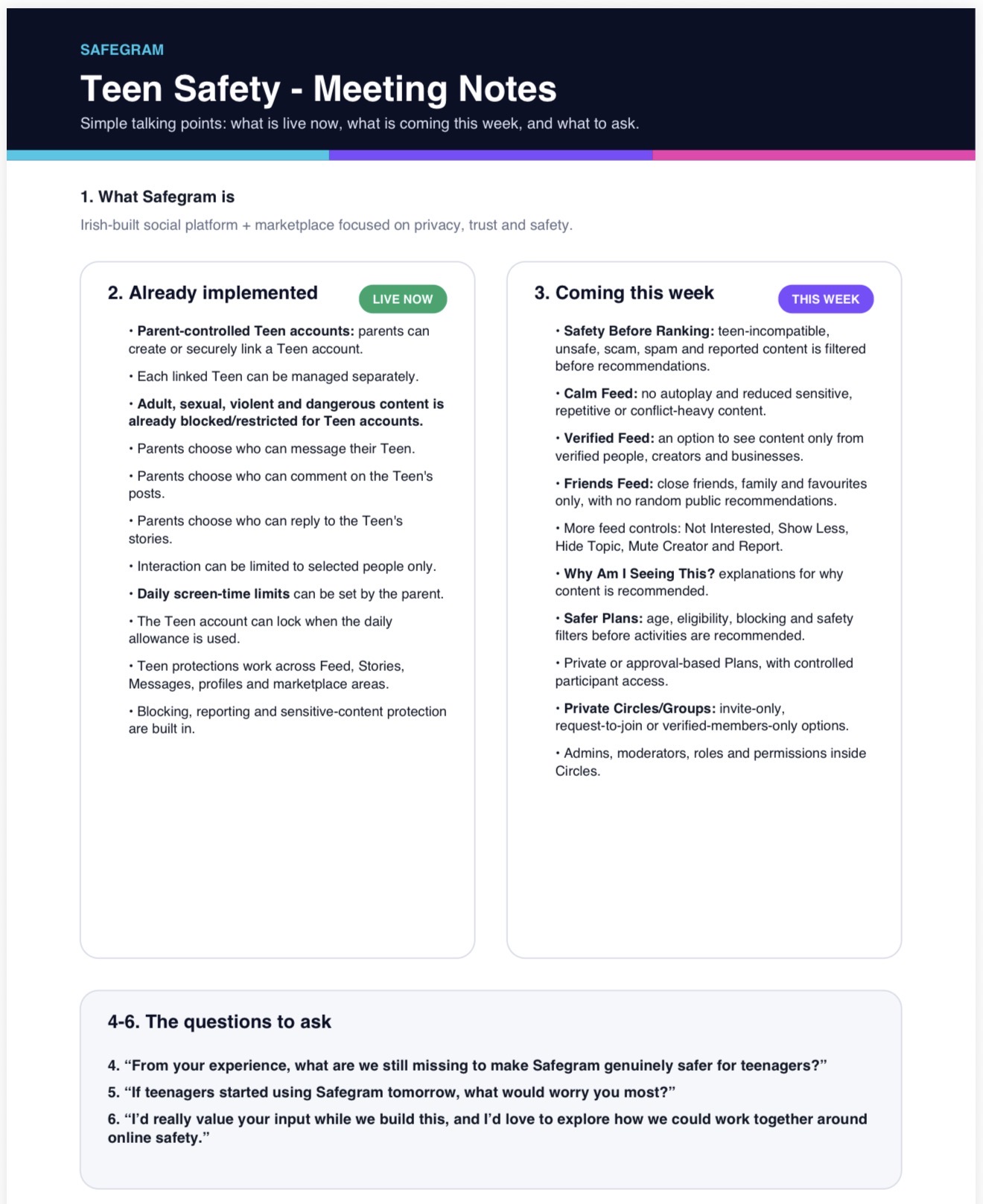
Yes, because Safegram requires identity verification and eliminates anonymous accounts, the environment is significantly less prone to the bullying and predatory behavior found on unverified networks. Furthermore, the absence of engagement-based algorithms reduces the risk of compulsive usage.
If you are tired of being tracked and exploited, it is time to choose a network that respects your rights. Join the thousands of users who have transitioned to a more secure digital life. Experience the future of social networking and commerce today by joining Safegram.
Try Safegram
Privacy-first social and a verified marketplace, built in Dublin.