
Verified in the Background, Private in Public: How Age and Identity Checks Can Coexist Online
Age and identity checks can coexist online, ensuring safety and accountability while respecting user privacy and public pseudonymity.

Online safety debates often collapse three different questions into one: How old are you? Who are you? And what name should other people see? They do not have to produce the same answer. Europe is building privacy-preserving age proof that can confirm an age threshold without revealing unnecessary identity data. At the same time, trusted social and marketplace platforms may still need to verify the real person behind an account. The challenge is to verify what matters without forcing everyone to expose their legal identity publicly.
Key takeaways
- The European Commission’s age-verification solution is designed to prove an age threshold without revealing the user’s exact age, identity or other unnecessary personal details to the online service.
- The European Digital Identity Wallet framework is built around selective disclosure, allowing a person to share a needed attribute rather than every identity field.
- Age assurance and identity verification solve different problems: one can determine whether a user is old enough, while the other can establish who the real person is.
- Public pseudonymity can coexist with private verification. A user can appear under a nickname or anonymous-facing profile while the platform still knows that a real person has completed an identity check.
- Safegram’s current model requires identity verification for users who want full use of the app. Depending on the flow, that verification is performed in the background through Didit.me or Stripe; the verified identity does not have to become the public profile name.
- Safegram is looking to implement support for the European Digital Identity Wallet when it is available and appropriate for its verification flows. That is a planned integration, not a live feature.
- The proposed EU KIDS Act adds momentum to age assurance for social media, but it remains proposed legislation and can change during the legislative process.
The false choice between verification and privacy
Online verification is often described as a binary choice.
Either everyone is anonymous and nobody can be trusted, or everyone uploads identity documents and uses a legal name in public.
That is an unnecessarily crude model.
A modern trust system can separate at least three questions.
First: is this person above the required age threshold?
Second: has a real identity been verified behind the account?
Third: what identity does the person choose to present publicly?
Those questions can be answered independently.
A platform might know that a user has completed a genuine identity check without displaying that person’s passport name to the rest of the community.
It might also receive a simple proof that the user is 15+, 18+ or another required age without receiving the person’s full date of birth.
That separation is increasingly important because online trust and online privacy are both legitimate design requirements.
Europe’s age-proof model is built around minimum disclosure
The European Commission says its age-verification solution is designed so users can prove they meet an age threshold without revealing their exact age, identity or other unnecessary personal details to the platform they are visiting.
The system can be offered as a standalone age-verification application or integrated into European Digital Identity Wallets.
The Commission’s technical approach is based on selective disclosure: the relying service receives the fact it needs rather than an entire identity record.
For example, a platform may need to know only:
“Yes, this user is 15 or older.”
It does not automatically need the user’s legal name, passport number, full date of birth or home address.
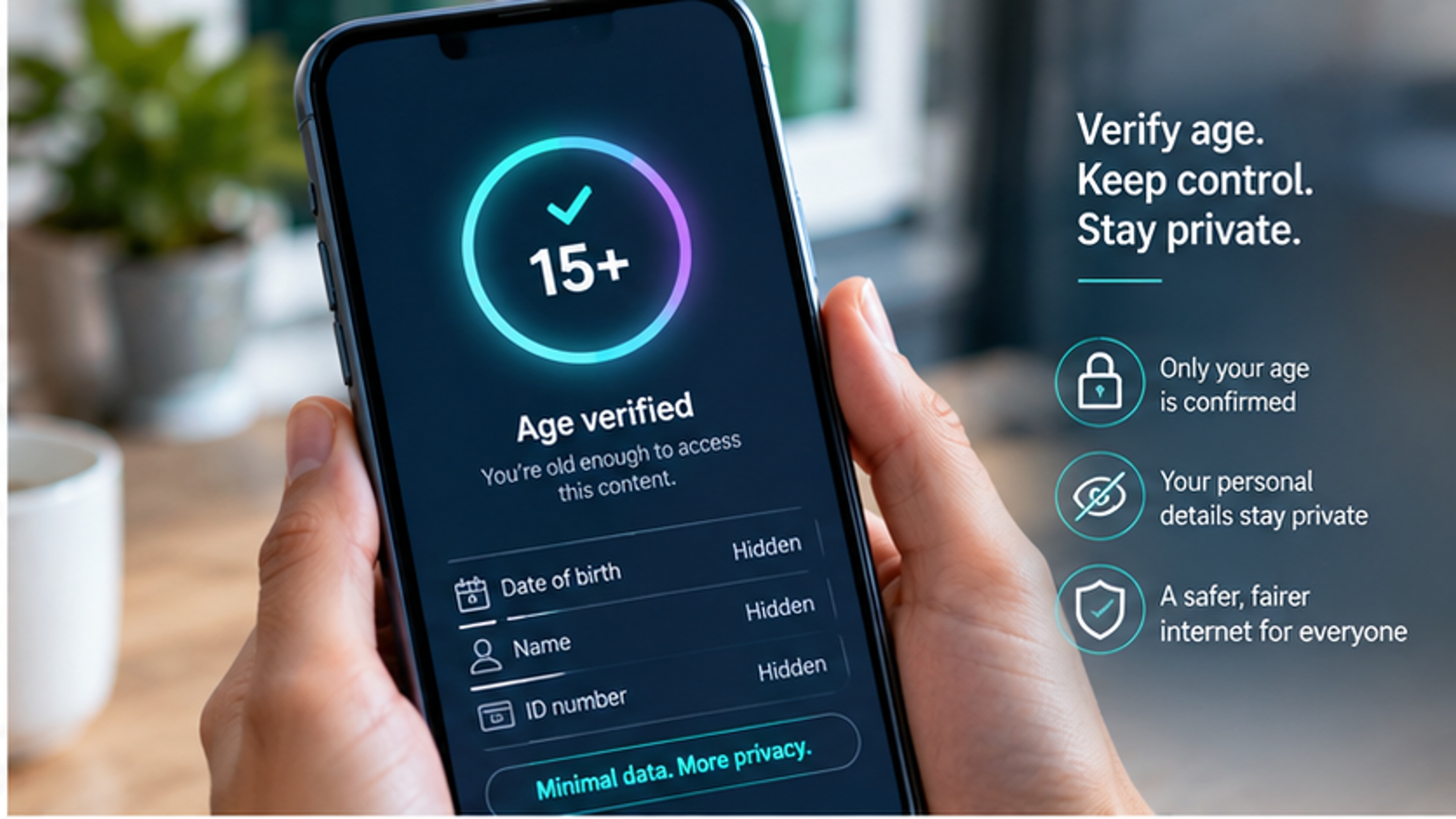
Europe’s age-verification model is designed to confirm an age threshold without passing unnecessary identity data to the online service.
Age proof does not mean identity is never verified
This distinction is crucial.
A privacy-preserving age credential may be created from reliable identity information. The Commission’s own material explains that age proof can be set up using sources such as a biometric passport or identity card, national electronic identity, a banking app or an in-person process.
The privacy gain comes from what is later disclosed to the online service.
The underlying process can establish a trustworthy age attribute while the website or platform receives only the minimum result required.
This is very different from saying that identity never matters.
For some services, identity verification remains important for fraud prevention, marketplace accountability, business verification, payments, high-risk functions or access to the full set of platform features.
The better question is not “identity verification or privacy?”
It is “which party needs which information, for what purpose, and for how long?”
A verified person does not need a public real-name profile
One of the most useful distinctions for social platforms is the difference between verification and public identity.
A person can be verified privately and still use a nickname publicly.
A creator can build an audience under a stage name while the platform has verified the individual behind the account.
A user may choose an anonymous-facing profile for ordinary social participation while still having completed an identity check with the platform.
Strictly speaking, that person is not anonymous to the verification layer. They are anonymous or pseudonymous to other users.
That difference matters because public exposure and platform accountability are separate design choices.
Public real-name policies can create their own risks for people who have legitimate reasons not to expose their legal identity widely. Background verification can provide a different model: accountability to the platform without mandatory identity disclosure to the crowd.
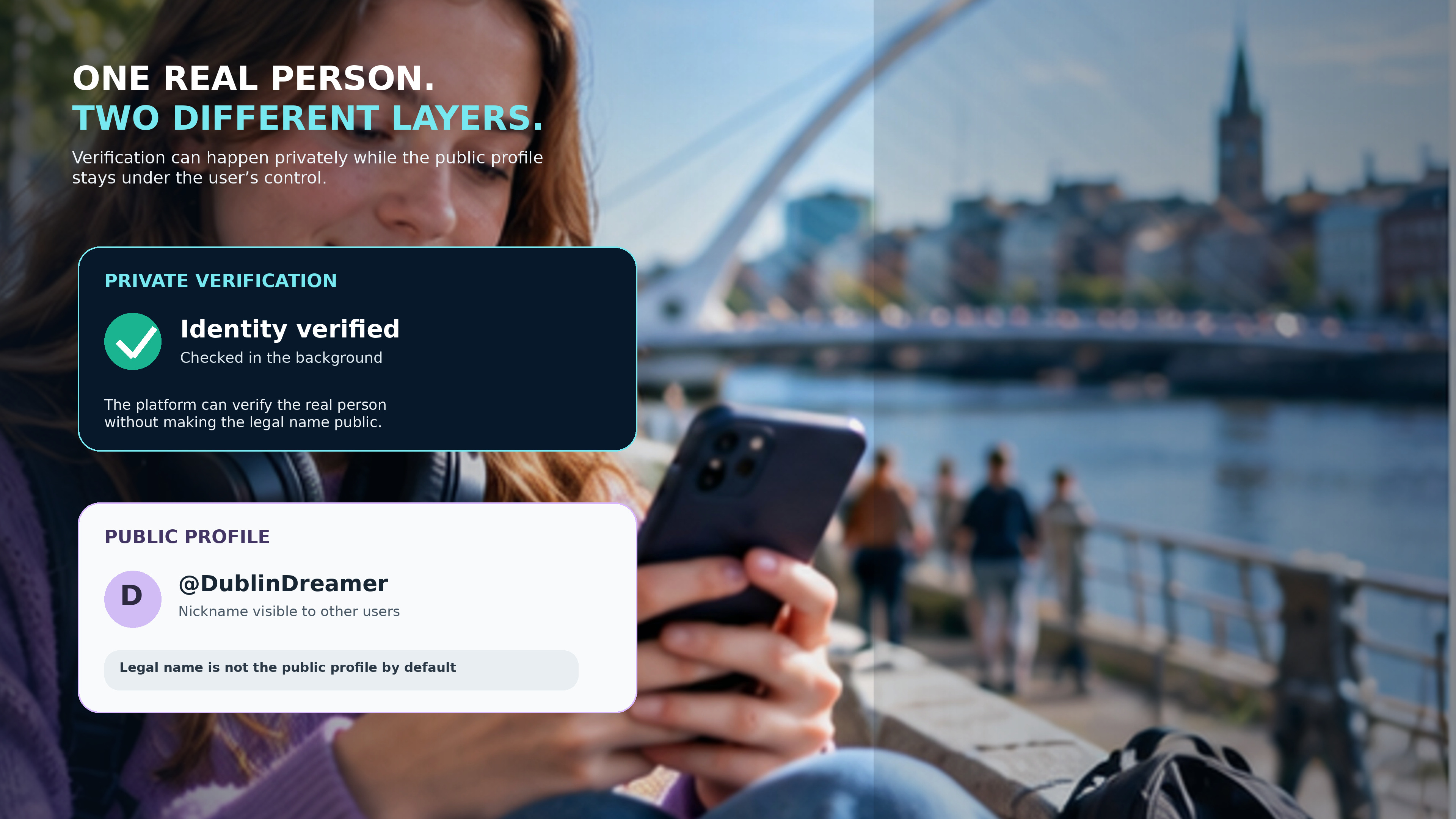
A verified user can remain pseudonymous to other users: Safegram can verify the real person in the background while the public profile uses a nickname or anonymous-facing identity.
How safegram’s model works
Safegram’s current model is designed around that separation.
Users who want the full use of the app are required to complete identity verification.
The identity check happens in the background. Depending on the verification or payment flow, Safegram uses Didit.me or Stripe.
Didit describes its service as identity-verification technology used by businesses to confirm who a user is, including ID-document checks, liveness and face matching. Stripe Identity similarly provides programmatic identity verification and supports document and selfie-based checks.
For Safegram, passing that verification does not mean a legal name has to become the user’s public identity.
A user can use a nickname or, where the product allows it, maintain an anonymous-facing presence to other users. The platform-level trust signal and the public-facing profile are separate.
That distinction is central to the Safegram model:
real person in the background;
chosen identity in public;
stronger controls when age matters;
and clearer verification where commerce or higher-trust interactions require it.
Verification should establish accountability without unnecessarily forcing personal identity into the public feed.
Identity, age and public profile should be three separate layers
This layered model is useful because the three signals serve different purposes.
Identity layer
The identity layer answers: has the platform verified the real person behind this account?
For Safegram users seeking full functionality, this is the layer supported today through background identity-verification flows such as Didit.me or Stripe.
Age layer
The age layer answers: does the user meet the age threshold required for a particular experience?
Europe’s age-verification architecture points toward a model in which the platform can receive that answer without collecting a complete identity record.
Public profile layer
The public profile layer answers: what should other people see?
That could be a real name, a creator name, a nickname or an anonymous-facing identity depending on the account and product context.
Conflating these layers encourages unnecessary data exposure.
Separating them gives platforms more control over safety while giving users more control over public identity.
Where the european digital identity wallet could fit
The European Digital Identity Wallet is designed to let people securely share selected identity data and electronic attestations with public and private services.
The Commission says Member States are expected to offer at least one wallet and that the age-verification solution has been designed to interoperate with the wallet framework.
That creates a potentially useful future path for platforms.
Instead of asking a user to repeat the same document-verification process for every service, a platform could potentially rely on a trusted wallet credential for the particular fact it needs.
For an age-gated experience, that might be a simple age threshold.
For another use case, a stronger verified identity credential may be appropriate.
Safegram is looking to implement EUDI Wallet support once the wallet is available and the relevant integration is mature enough for its product and compliance requirements.
That is a future integration. Safegram should not describe EUDI Wallet verification as live until it has actually been implemented, tested and released.
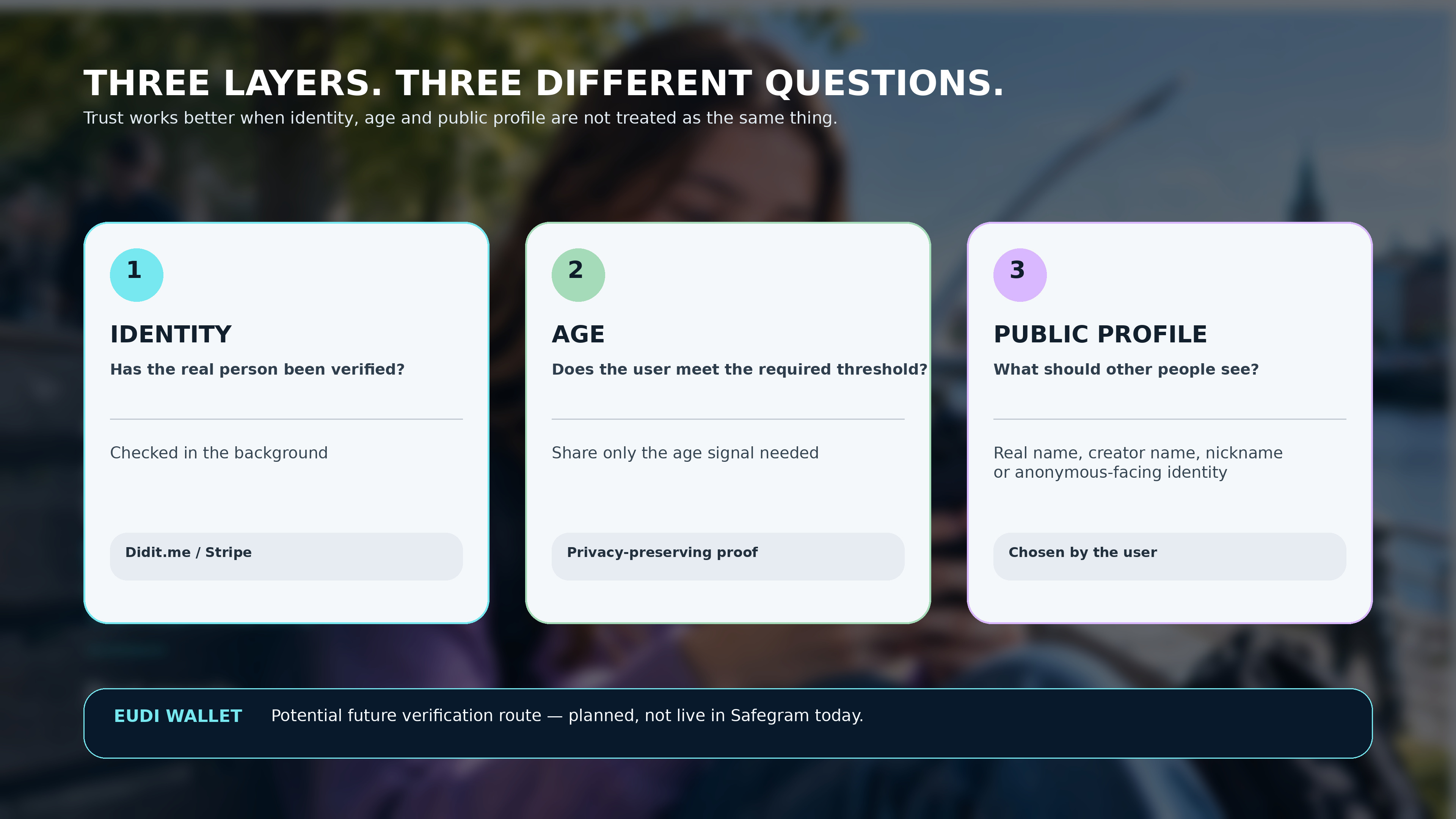
Identity, age and public profile are different trust layers. Safegram uses background identity verification today and is exploring EUDI Wallet support as a future route.
The proposed kids act makes the distinction more important
The European Commission’s proposed KIDS Act places age assurance near the centre of a proposed age-based model for social-media access.
Because it is proposed legislation, the final text may change through the legislative process.
But the policy direction raises a practical issue for every platform: if age rules become more specific, the age signal has to become more reliable.
That does not automatically justify making every user publicly identifiable.
The Commission’s own age-verification architecture points in the opposite direction: prove the relevant threshold while minimising what the service learns.
Identity checks can still exist where the service has a separate reason to verify identity.
The two mechanisms are complementary rather than interchangeable.
Minimum disclosure should apply even when identity is verified
Background verification is not a licence to collect or expose unlimited information.
A trustworthy system should still define:
what data is required;
why it is required;
which provider processes it;
what result the platform receives;
how long information is retained;
what is shown publicly;
and what happens when the verification is no longer needed.
Didit states that it provides verification technology to businesses and that the business requesting verification controls what is collected and how long it is kept. Stripe Identity provides controls for identity-verification flows and data handling.
For platforms, that means the privacy responsibility does not disappear simply because a specialist provider performs the check.
Good verification architecture reduces unnecessary circulation of identity data.
What a verification badge should actually mean
Verification also needs precise language.
A verification signal should not imply that a person is trustworthy in every possible context.
Identity verification can establish that a real identity was checked.
Age assurance can establish that an age threshold was met.
Business verification can establish specific information about a company or representative.
None of those automatically guarantees good behaviour, product quality or transaction outcome.
A useful trust system tells users exactly what has been verified and avoids turning a badge into a vague promise.
That principle applies to Safegram as well.
The platform can use verified identity to make impersonation harder and accountability stronger while still allowing public nickname-based participation.
The better model: accountable without being overexposed
The internet does not have to choose between total anonymity and permanent public identification.
A more nuanced model is possible.
A platform can verify that a real person exists behind an account.
It can separately verify age when an age threshold matters.
It can let that person choose a public nickname or anonymous-facing identity.
And it can reveal only the minimum information required for each interaction.
That is the distinction Europe’s privacy-preserving age architecture is beginning to make more concrete.
For Safegram, it is also the direction of the product model: verification in the background, choice in the public profile, and a planned path toward EUDI Wallet support when the European infrastructure is ready.
The strongest trust layer may not be one that tells everyone everything about you.
It may be one that proves the right thing to the right party — and keeps the rest private.
Frequently asked questions
Does Safegram verify users’ real identities?
Yes. Safegram’s current model requires users who want full use of the app to complete identity verification. Depending on the flow, the background verification is handled through Didit.me or Stripe.
Does a verified Safegram user have to show their legal name publicly?
No. Identity verification and public profile identity are separate. A user can use a nickname or, where the product allows it, an anonymous-facing identity while the underlying account has been verified.
Is that user completely anonymous?
Not to the verification layer. The important distinction is public anonymity or pseudonymity: other users may not see the person’s legal identity even though Safegram has received a successful verification result through its verification process.
What is the difference between age verification and identity verification?
Age verification can answer whether a person is above a particular threshold. Identity verification establishes who the person is. A service may need one, the other or both depending on the use case.
Does the EU age-verification system reveal a user’s identity to the website?
The Commission says its approach is designed so the online service receives the age-threshold result without learning the user’s exact age, identity or other unnecessary personal details.
Is Safegram already using the European Digital Identity Wallet?
No. Safegram is looking to implement EUDI Wallet support once it is available and appropriate for its verification flows. It should be treated as planned, not live.
Does background verification guarantee that a user will behave well?
No. Verification provides a stronger accountability signal, but it does not guarantee future behaviour, transaction quality or compliance with platform rules.
Source references
European Commission — EU age-verification solution and April 2026 rollout recommendation. Used for the privacy-preserving age-threshold model, standalone-app option, Digital Identity Wallet interoperability and the end-of-2026 rollout objective.
European Commission — European Digital Identity Wallet materials and Age Verification Manual. Used for selective disclosure and the distinction between a full identity credential and a limited age proof.
European Commission — KIDS Act proposal, September 2026. Used for the proposed age-based social-media framework. The article treats the KIDS Act as proposed legislation, not final law.
Didit — official identity-verification documentation and Help Centre. Used to describe Didit as background identity-verification technology capable of document, liveness and face-match checks.
Stripe — Stripe Identity official documentation. Used to describe Stripe’s identity-verification capabilities and user-consent/data-handling model.
More from Safegram
Try Safegram
Privacy-first social and a verified marketplace, built in Dublin.