
Who Gets Paid When AI Learns From Human Work? Dublin Is About to Ask
Dublin hosts a major AI copyright debate on 14 October. What do EU rules mean for Irish creators, publishers, musicians and businesses using AI?
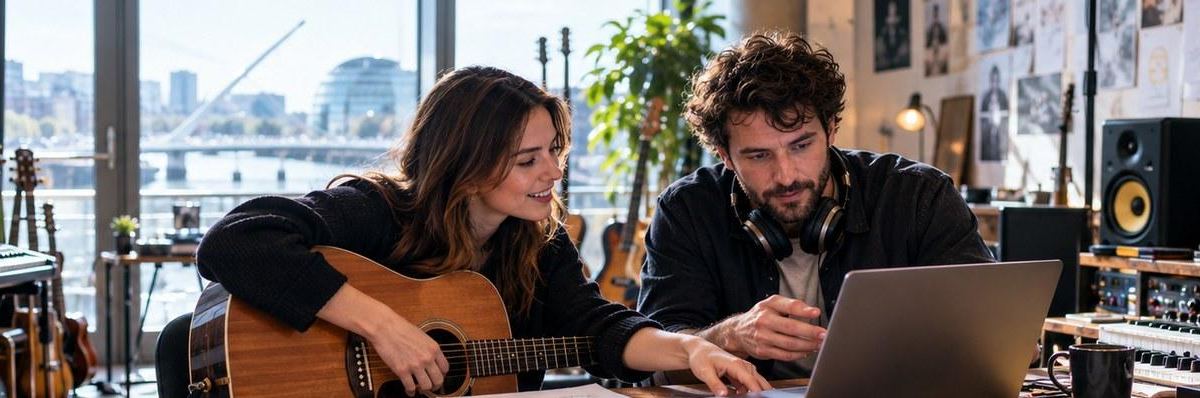
Dublin will host the “Copyright and Human Creativity in the Age of AI” conference on Wednesday, 14 October 2026, at the Irish Film Institute in Temple Bar. The event is part of Ireland’s Presidency of the Council of the European Union, organised by NewsBrands Ireland and the Irish Recorded Music Association (IRMA), and endorsed by the Department of Enterprise, Tourism and Employment. Its agenda puts licensing, enforcement and trust at the centre of the conversation. [1]
The issue is larger than whether a machine can write an article or generate a convincing song. News stories, photographs, recordings, illustrations and videos are made by people who invest time, expertise and money. When AI systems learn from enormous collections of material, creators and rights holders want to know which works were used, under what legal basis, and whether there is a fair route to payment.
AI developers, meanwhile, argue that broad access to information is important for research, competition and the development of useful tools. Europe’s challenge is to make room for innovation while ensuring copyright rules are meaningful in practice. The conference has not yet taken place; its published programme is evidence of the questions being debated, not of any decision or agreement reached.
What the EU AI Act already requires
The EU AI Act already places specific obligations on providers of general-purpose AI models. Under the European Commission’s guidance, these providers must have a policy for complying with EU copyright law and must publish a sufficiently detailed summary of the content used to train their models. The requirements began applying in August 2025, with the Commission moving to full enforcement of the general-purpose model obligations from August 2026. [2]
That matters because transparency is a starting point for accountability. But a published training-data summary is not the same as a complete list of every work, a licence for every use, or an automatic payment to a photographer or songwriter. Questions about permission, exceptions, rights reservations and remedies still depend on the underlying copyright framework and the facts of a particular use.
There is another distinction worth making. The AI Act’s rules on labelling certain AI-generated content address whether audiences can recognise synthetic or manipulated material. Copyright and licensing address whether protected work may lawfully be used. A label does not replace a licence, and a licence does not automatically tell viewers whether a picture or voice was generated by AI. [3]
Why the creative industries are pressing for fair licensing
Ireland’s music sector has made its position increasingly explicit. On 2 October, the Irish Music Rights Organisation (IMRO) backed a joint statement by independent music-publishing organisations IMPEL and IMPF calling for generative-AI licensing built on fair, transparent and sustainable principles. Their concern is not simply that AI exists; it is that the value of songs, songwriters and publishers should be recognised as new business models emerge. [4]
The European Parliament has also called for stronger transparency and fair remuneration when copyrighted material is used in generative AI. Its March 2026 position advocates a workable licensing market that includes smaller rights holders, not just major catalogues. These are parliamentary demands and policy proposals, not a new blanket rule that every AI output automatically triggers royalties. [5]
Publishers are among the rights holders asking for transparency over AI training and content licensing. | AI-generated editorial illustration.
A workable market would have to solve difficult practical problems: identifying the relevant rights holder, distinguishing licensed material from material used under an exception, recording consent or reservations, pricing uses fairly and making disputes manageable. For a large publisher, that might mean collective agreements and audit processes. For a freelance photographer or a small Irish video studio, it may begin with clear contracts and proof of authorship.
For independent creators, the real issue is control
Consider a Dublin videographer who films a restaurant campaign, a designer who creates a logo, or a musician who licenses a short track for a promotional reel. Each may use AI tools in their workflow. Each also needs to know whether a client is buying a finished deliverable, a limited right to reuse it, or a much broader licence covering editing, redistribution and AI-related uses.
This is where the design of commercial platforms matters. On Safegram Exchange, verified creators and businesses can build a recognisable presence around the services and products they offer. That can help buyers understand whom they are dealing with and can support longer-term relationships rather than one-off anonymous transactions. It does not, by itself, prove copyright ownership, stop unauthorised copying or grant permission for AI training. Those protections require clear terms, evidence and appropriate legal processes.
The wider opportunity for creator-focused platforms is to make the commercial relationship easier to follow: who made the work, who commissioned it, what was delivered, what rights were agreed and how the creator can be contacted again. Identity verification is one useful component of trust, not a substitute for copyright law.
What Irish businesses should check before using AI content
A business does not need to become a copyright lawyer to ask better questions. Before using AI-generated visuals, music, copy or video in a paid campaign, it should check the tool’s commercial terms, keep records of human contributions and source assets, confirm whether a freelancer’s agreement covers the intended uses, and avoid implying that AI-generated people or testimonials are real customers.
For original commissioned work, a written agreement should spell out ownership, permitted uses, exclusivity, attribution, payment, sublicensing and whether the material may be fed into third-party AI systems. Businesses should also consider privacy, personality rights, advertising standards and the AI Act’s applicable transparency duties. These are practical risk-reduction steps, not a guarantee that a particular use is lawful.
Irish creators and local businesses increasingly combine original video production with AI-assisted tools. | AI-generated editorial illustration.
What to watch at the Dublin conference
The conference programme includes European Commission Executive Vice-President Henna Virkkunen, enterprise minister Peter Burke, intellectual-property scholar Eleonora Rosati, publishers, music-sector representatives and creators. Panels will address an ethical framework for AI, a fair EU licensing market and effective enforcement. Registration is listed as closed. [1]
Three questions will be especially important after the speeches: Can a small creator realistically discover when their work was used? Can rights holders and AI companies negotiate licensing at a price and scale that works for both? And can consumers tell when they are interacting with authentic human work, AI-assisted work or synthetic content?
The answers will not be settled by a single event. But they will influence whether Europe’s AI economy rewards the people whose creativity makes its products useful. For Ireland, with its strong technology sector and vibrant creative businesses, that is a question about future jobs and enterprise as much as law.
Key takeaways
- Dublin’s 14 October conference is scheduled to examine copyright, licensing and human creativity in the age of AI; it has not yet taken place.
- EU rules require general-purpose AI model providers to adopt copyright-compliance policies and publish training-content summaries, but those requirements do not automatically settle every licensing dispute.
- Irish music organisations and European lawmakers are pressing for fairer licensing and stronger transparency, while AI developers seek workable conditions for innovation.
- Creators and businesses should document authorship, usage rights, AI-related permissions and commercial terms before publishing or commissioning content.
Frequently asked questions
Does AI training on copyrighted material always require permission?
Not in every circumstance. The answer depends on applicable copyright law, exceptions, rights reservations and the particular activity. A public website is not automatically a blanket licence for every AI use.
What does the EU AI Act require of general-purpose AI model providers?
Among other obligations, covered providers must implement a copyright-compliance policy and publish a sufficiently detailed summary of training content. These duties are distinct from the underlying question of whether a particular use infringes copyright.
Does labelling AI-generated content mean it is copyright-cleared?
No. Transparency labels help audiences understand that content is synthetic or manipulated; they do not establish that source material was lawfully licensed.
Can Irish businesses use AI-generated images commercially?
Potentially, subject to the tool’s terms, applicable law and the circumstances of use. Businesses should assess third-party rights, privacy, misleading advertising and relevant AI-transparency requirements.
How can a freelance creator protect commissioned work?
Use a written agreement, retain original project files and timestamps, define ownership and usage rights, specify whether AI training or reuse is permitted, and document payments and approvals. Seek professional advice for significant disputes.
When is the Dublin AI copyright conference?
Wednesday, 14 October 2026, at the Irish Film Institute in Temple Bar, Dublin 2. The organiser’s website currently says registration is closed. [1]
For creators and businesses
The future of creative commerce depends on both useful technology and relationships people can trust. Explore Safegram and Safegram Exchange to discover how verified profiles and cross-category services can help creators and businesses connect: https://safegram.com
Sources and verification
[1] Copyright & Human Creativity in the Age of AI — official conference website, event details and agenda (accessed 11 October 2026): https://copyrightconference.ie/
[2] European Commission — Guidelines on obligations for General-Purpose AI providers: https://digital-strategy.ec.europa.eu/en/faqs/guidelines-obligations-general-purpose-ai-providers
[3] European Commission — Code of Practice on Transparency of AI-generated Content: https://digital-strategy.ec.europa.eu/en/policies/code-practice-ai-generated-content
[4] Irish Music Rights Organisation — IMRO Supports IMPEL and IMPF Statement on Fair Licensing for Generative AI, 2 October 2026: https://imro.ie/industry-news/imro-supports-impel-and-impf-statement-on-fair-licensing-for-generative-ai/
[5] European Parliament — Protecting copyrighted work and the EU’s creative sector in the age of AI, March 2026: https://www.europarl.europa.eu/news/en/press-room/20260306IPR37511/proteggere-il-diritto-d-autore-e-il-settore-creativo-dall-ia
[6] Irish EU Presidency — Digital Week 2026, 12–16 October: https://irish-presidency.consilium.europa.eu/en/news/digital-week-2026/
More from Safegram
Try Safegram
Privacy-first social and a verified marketplace, built in Dublin.