
The Hidden Price of Play: Why Europe Is Scrutinising In-Game Purchases
European authorities are investigating how in-game purchases and virtual currencies are presented, highlighting the need for transparent digital commerce and clear pricing.
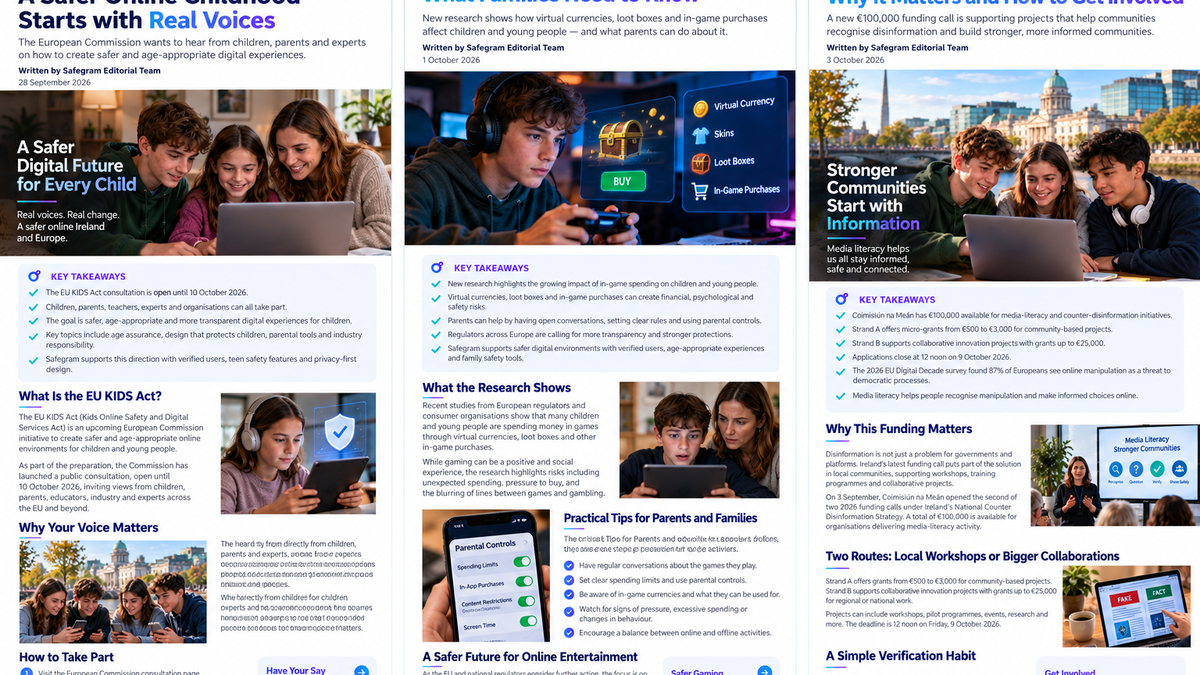
Buying a €1.99 bundle inside a game can feel very different from spending €1.99 in a shop. Virtual currencies, layered pricing and fast purchase flows can make the real cost harder to judge. Irish and European consumer authorities are now examining whether some practices comply with consumer law.
Key takeaways
- On 1 October 2026, Ireland’s Competition and Consumer Protection Commission (CCPC) said it and other European consumer authorities had launched coordinated action involving nine online gaming companies.
- Authorities are examining in-game purchases, virtual currencies, transparency around costs, consumer rights and the fairness of terms and conditions.
- The action is an investigation into potential breaches; it is not a finding that every named company or game has broken the law.
- For families, the simplest protection is to translate virtual currency back into euros before approving a purchase and review device-level purchase controls.
- Safegram does not currently operate a gaming or virtual-currency marketplace. Its relevance is broader: clearer identity, transaction context and safer digital commerce are part of its verification-first direction.

A €9 purchase should feel like a €9 purchase
Digital games increasingly contain shops inside the game itself. Players may buy cosmetic items, extra lives, passes or other digital content, sometimes using an intermediary virtual currency.
That extra layer matters. A price shown as 500 coins asks the player to perform a second calculation: what did those coins cost in real money, and how much of the bundle will remain after the purchase?
On 1 October, the CCPC said it had joined consumer authorities across Europe in coordinated action involving nine online gaming companies. According to the regulator, the work is examining in-game purchases, in-game virtual currencies, consumer rights, price transparency and fairness of terms.
The distinction between scrutiny and guilt is essential. Regulatory action into potential breaches is not the same as a final finding that a company has violated the law.
Why virtual currency can make prices harder to read
Virtual currency is not automatically harmful. It can support a game economy and make digital purchases technically convenient.
The consumer issue arises when the conversion between real money and game currency becomes difficult to understand, when bundles leave unusable balances, or when the player cannot easily see the euro cost at the moment a purchase decision is made.
European consumer authorities have been pressing the games sector for greater transparency and fairness around in-game currencies. The CCPC says earlier discussions with industry federations did not produce satisfactory solutions, after which authorities carried out a larger market check and identified games for further action.
For a family, a useful rule is simple: before pressing buy, say the real-money price out loud.
The five-second family check
Before approving an in-game purchase, ask:
-
What does this cost in euros, not coins or gems?
-
Is this a one-off purchase or something that renews?
-
What exactly is being received?
-
Will unused virtual currency remain?
-
Can the purchase be reversed if it was accidental?
Those questions slow down a transaction just enough to restore context.
Parents can also use operating-system and console controls that require approval or authentication before purchases. The exact controls vary by device and service, so families should check the current settings on the device being used.
Children deserve prices they can understand
This issue intersects with a wider European move toward age-appropriate digital design.
The European Commission’s proposed EU KIDS Act, published on 17 September 2026, would strengthen safety-by-design expectations for services used by minors. The proposal is not final law. Existing Digital Services Act protections for minors already require covered platforms to take appropriate and proportionate measures to ensure a high level of privacy, safety and security.
The principle is relevant beyond social networking: when children interact with digital systems, interfaces should not depend on confusion to generate engagement or spending.

What irish consumers can do if something goes wrong
Keep receipts and screenshots of the purchase screen, item description and any communication with the provider.
Start with the game or platform’s support and refund process. If you believe a trader has misled you or breached consumer rules, the CCPC provides consumer information and complaint routes. Where an unauthorised payment or fraud is suspected, contact the bank or payment provider promptly.
Not every disappointing purchase is a scam or a legal breach. Clear records make it easier to distinguish a technical problem, an accidental purchase, a refund dispute and potentially misleading conduct.
Where safegram fits — live, developing and planned
Safegram’s relevance to this story is not gaming. Safegram should not imply that it currently provides in-game currencies, game purchases or gaming-specific parental controls.
LIVE: Safegram is available on iOS and Android. Verification, social profiles and Safegram Exchange are part of the live platform, and businesses and creators must be verified before adding products or services to Exchange.
DEVELOPING / BETA: Safegram continues to develop and test marketplace, booking, discovery, messaging and AI-assisted experiences. Individual flows can change during rollout.
PLANNED / EXPANDING: Stronger teen/family protections, age-aware contact boundaries, family notifications and additional automated safety signals remain part of the broader roadmap and should not be described as universally deployed until marked live.
The useful connection is a design principle: digital transactions should make it easier to understand who is involved, what is being bought and what it really costs.
What good digital commerce should feel like
The best purchase flow is not the one that makes people spend fastest. It is the one that lets them make an informed decision without unnecessary friction or confusion.
That means recognisable prices, clear sellers, understandable refund routes, age-appropriate design and enough context to know what happens after tapping “buy”.
As regulators examine the economics inside games, that standard is likely to matter well beyond gaming.
Frequently asked questions
What did the CCPC announce on 1 October 2026?
The CCPC said it and European consumer authorities had launched coordinated action involving nine online gaming companies over potential consumer-law issues including in-game purchases, virtual currencies, pricing transparency and terms.
Does this mean the companies broke the law?
No. The announcement concerns potential breaches and regulatory action. A launch of an investigation or coordinated action is not itself a final finding of wrongdoing.
Are virtual currencies illegal?
No. The concern is how they are presented and used, including whether consumers can understand real-world costs and exercise their rights.
What is the easiest way to judge an in-game purchase?
Convert the virtual currency into euros before buying and check exactly what the purchase provides.
Should parents disable all in-game purchases?
That is a family decision. A practical middle ground is to require authentication or parental approval and discuss the real-money cost before purchase.
Does the EU KIDS Act already apply?
No. It is a legislative proposal published in September 2026. Existing EU rules, including the Digital Services Act, already contain protections for minors.
Does Safegram sell virtual game currency?
No. Safegram should not be presented as a gaming platform or virtual-currency marketplace.
Are all Safegram teen/family protections live?
No. Some core platform and verification functionality is live, while additional teen/family protections are developing or planned.
Source references
-
Competition and Consumer Protection Commission, “CCPC and EU consumer authorities launch joint actions into online gaming practices”, 1 October 2026.
-
European Commission, “EU KIDS Act to restrict social media platforms’ access to children in the EU”, 17 September 2026.
-
European Commission, “Proposal for EU KIDS Act — EU Keeping Internet Digital Spaces Accountable and Trustworthy”, 17 September 2026, updated 2 October 2026.
-
Competition and Consumer Protection Commission, “Scrolling Smart: Check Before You Click”, 17 March 2026.
-
Competition and Consumer Protection Commission, “How to spot a scam”, 23 April 2026.
More from Safegram
Try Safegram
Privacy-first social and a verified marketplace, built in Dublin.