
Ireland’s Child Online Safety Reality Check: What Irish Children Are Telling Us in 2026
New reports from CyberSafeKids and Coimisiún na Meán reveal Irish children's digital lives, highlighting AI use, content exposure, and the need for privacy-preserving safety.
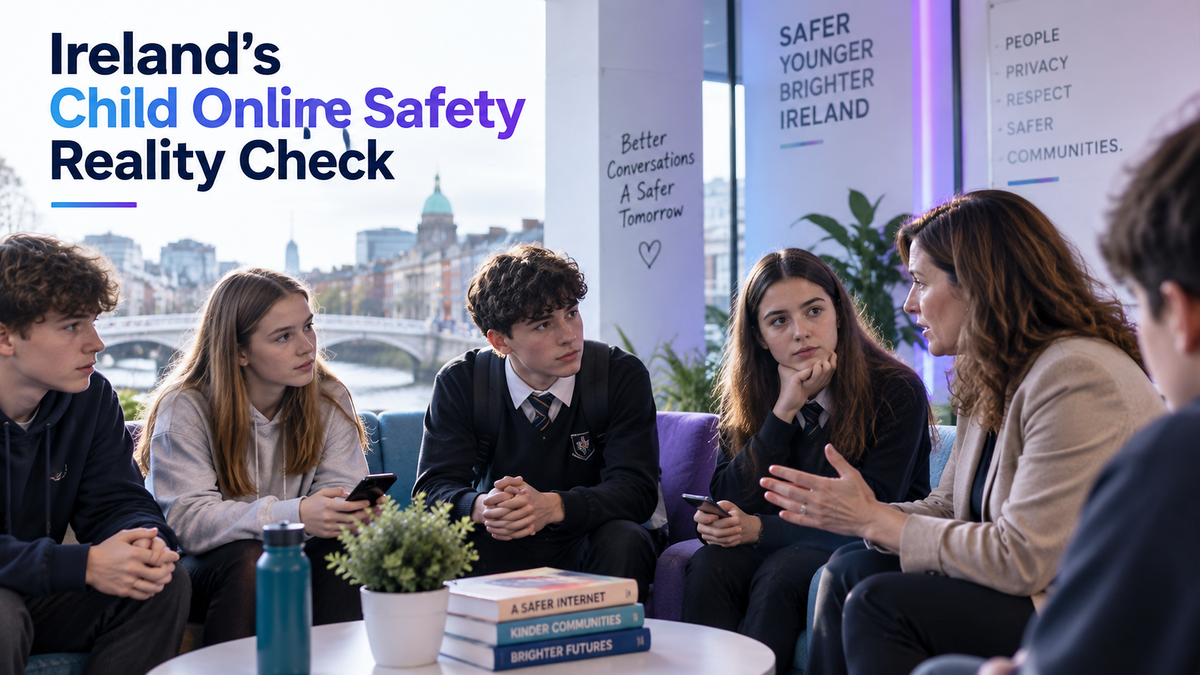
Ireland’s latest online-safety research sends a clear message: children are deeply embedded in digital life, AI use is accelerating quickly, and exposure to upsetting content remains stubbornly common. The answer is not simply to ban young people from the internet. It is to build safer systems, stronger education and privacy-respecting age assurance into the architecture of the online world.
Key takeaways
- CyberSafeKids’ 2026 report draws on responses from more than 7,000 Irish children aged 8–15.
- 55% of 8–12-year-olds and 76% of 12–15-year-olds said they had used AI chatbots for homework, friendship or information.
- 26% of 8–12-year-olds and 25% of 12–15-year-olds reported content or unsolicited contact online that bothered them.
- 70% of 8–12-year-olds still reported accounts on 13+ social-media apps.
- Coimisiún na Meán’s September 2026 research found most children prefer better online-safety education to an outright social-media ban.
- The EU is moving toward privacy-preserving age verification that can prove an age threshold without revealing a person’s identity or exact date of birth.
A digital childhood is now the default
For Irish children, the internet is not a separate place. It is where friendships happen, homework gets done, entertainment is discovered, games are played, identities are explored and increasingly where AI is used for advice and information.
That is why the 2026 data matters. CyberSafeKids’ latest annual snapshot, based on more than 7,000 pupils aged 8–15 during the 2025–26 academic year, shows that many of the biggest digital trends are no longer emerging trends. They are already normal parts of childhood.
The headline shift is AI. CyberSafeKids reports that 55% of children aged 8–12 and 76% of those aged 12–15 had used AI chatbots. That is a dramatic rise from the previous year, when the equivalent figures were 26% and 36%.
For parents, schools, policymakers and technology companies, this changes the safety conversation. It is no longer enough to ask what children are doing on social media. We also need to ask what they are asking AI systems, what advice they are receiving, how those systems handle personal information and whether young users can recognise when an answer is wrong, manipulative or simply invented.
The exposure problem has not gone away
CyberSafeKids found that 26% of 8–12-year-olds and 25% of 12–15-year-olds experienced online content or unsolicited contact that bothered them. The examples span misinformation, threats, violence, sexual material and dangerous ideas.
Among younger children, Roblox was the environment most often associated with those experiences; among older children, Snapchat was the most common. These findings do not mean those services are uniquely responsible for every harmful experience, but they do show where Irish children are spending time and where risk can surface.
The report also says 70% of 8–12-year-olds still have accounts on 13+ social-media apps. That figure is important because it underlines a recurring gap between minimum-age rules on paper and how platforms work in practice.
Education matters — and children are saying so
A separate report published by Coimisiún na Meán on 10 September 2026 adds another perspective. Its research into children’s digital lives found that the majority of children in Ireland believe it would be better to teach them how to stay safe online than to ban them from social media.
Parents and caregivers also leaned toward education over prohibition, while many respondents doubted a ban would be fully effective because children would find ways around it.
That does not mean rules are unnecessary. It means safety policy works best when education, age assurance, parental controls, platform design and enforcement reinforce one another.
The regulator is also showing that implementation now matters. On 8 September 2026, Coimisiún na Meán opened the first formal investigation under Ireland’s Online Safety Code, concerning X. The investigation includes concerns about the effectiveness of age-assurance mechanisms and parental controls. The case is ongoing, so no conclusion should be assumed, but its significance is clear: online-safety obligations are moving from policy text into active supervision and enforcement.
AI literacy is becoming a core part of digital-safety education as chatbot use rises sharply among young people.
Age assurance is changing — privacy is part of the solution
One of the biggest mistakes in online-safety debates is to frame privacy and child protection as opposites. Increasingly, European policy is moving in the other direction: age assurance should protect children without forcing everyone to reveal more personal information than necessary.
The European Commission’s age-verification approach is designed around anonymous proof of age. Its blueprint allows a user to prove they are above a required threshold without disclosing their exact age, name or other identity information to the online service. The system is intended to support age checks such as 18+, and the Commission says it can be adapted to other thresholds including 13+.
In April 2026, the Commission urged Member States to accelerate rollout of privacy-preserving age-verification solutions by the end of the year. The broader principle is important beyond adult-restricted services: platforms should collect the minimum information needed to apply safety rules.
Why this matters for the next generation of social platforms
The lesson from the latest research is not that young people should be excluded from digital life. It is that safety needs to be part of product architecture from the beginning.
For platforms serving teenagers, this can mean stronger separation between minors and unknown adults, default protections around discoverability and messaging, verified or age-assured access where appropriate, reporting and escalation systems, parental safety tools that do not expose private conversations, and clear rules for creators, businesses and advertisers interacting with younger users.
Safegram’s direction is based on that safety-by-design principle. Its platform is being developed around verified identities, privacy-first communication and additional family and teen safeguards. Safegram has stated that its teen-safety model is intended to limit adult discovery and direct contact with minors while preserving message privacy. Features and availability can change during rollout, so live, beta and planned capabilities should always be checked against the latest Safegram product release information.
The aim is not to remove autonomy from young people. It is to reduce unnecessary exposure to strangers, scams, impersonation and harmful interactions while allowing teenagers to participate in online communities with more appropriate boundaries.

Europe’s emerging age-assurance model aims to prove an age threshold while minimising personal-data disclosure.
AI literacy now belongs inside online-safety education
The increase in AI use deserves its own response. Schools and families need to move beyond a simple ‘use it/don’t use it’ argument.
Useful AI literacy should teach children how to verify claims, distinguish confidence from accuracy, avoid sharing sensitive personal information, understand that chatbots can generate convincing falsehoods, recognise manipulative or inappropriate responses, and know when to ask a trusted adult or teacher for help.
CyberSafeKids’ finding that almost half of children surveyed said nobody had talked to them about AI shows how quickly the technology has moved ahead of everyday guidance.
That gap can be closed. The same way schools teach road safety, consent, media literacy and cyberbullying awareness, AI literacy now needs a practical place in digital education.
Practical online safety starts with conversation, boundaries and settings that families understand and can use.
What parents can do now
Parents do not need to become technical experts. The most useful first step is conversation. Ask which apps, games and chatbots a child uses, what they like about them and whether anything online has ever made them uncomfortable.
Then check privacy settings together, agree what personal information should never be shared, explain that people online may not be who they claim to be, and make sure the child knows they can come to an adult without immediately losing access to their device.
For younger users, account age settings and parental controls should be reviewed regularly. For older teenagers, the emphasis can shift toward judgement, boundaries, consent and spotting manipulation.
What platforms should do next
The evidence points toward a practical model: make age and identity controls proportional to risk, keep personal-data collection minimal, separate minors from higher-risk adult interactions, design reporting systems that work in real time, make parental tools easy to find, and test safety systems with real young users instead of treating compliance as a checkbox exercise.
Most importantly, platforms should not force users to trade privacy for safety. Europe’s emerging age-assurance model shows that both can be designed together.
Frequently asked questions
What did CyberSafeKids find in its 2026 report?
CyberSafeKids surveyed more than 7,000 children aged 8–15 in Ireland. It found rapid growth in AI-chatbot use, widespread use of 13+ social platforms by younger children and continued exposure to upsetting content or unsolicited contact.
How many Irish children are using AI chatbots?
CyberSafeKids reported that 55% of children aged 8–12 and 76% of those aged 12–15 had used chatbots for homework, friendship or information during the 2025–26 academic year.
Do Irish children want social media banned?
Coimisiún na Meán’s September 2026 research found that the majority of children surveyed preferred better online-safety education to a social-media ban, and many believed a ban could be circumvented.
What is privacy-preserving age verification?
It is a system that confirms whether a user meets an age threshold without requiring the platform to receive their full identity or exact date of birth. The European Commission’s current blueprint is based on this principle.
Is age verification enough to keep children safe?
No. Age assurance is only one layer. Effective safety also requires product design, moderation, reporting tools, parental controls, media literacy, education and regulatory enforcement.
How does Safegram approach teen safety?
Safegram is building a privacy-first, verified social marketplace with additional teen and family protections. Its stated design direction includes limiting adult discovery and direct contact with minors while keeping private conversations private. Users should check the latest product release notes for the current status of specific live, beta and planned features.
Sources
- CyberSafeKids — The Year Little Changed, Report 2026.
- Coimisiún na Meán — Online Safety & Children’s Digital Lives research report, 10 September 2026.
- Coimisiún na Meán — Investigation commenced into X under Online Safety Code, 8 September 2026.
- Coimisiún na Meán — Online Safety Code.
- European Commission — The EU approach to age verification, updated 9 September 2026.
- European Commission — Commission urges Member States to rollout EU age verification app, 29 April 2026.
More from Safegram
Try Safegram
Privacy-first social and a verified marketplace, built in Dublin.