Ireland Is Funding the Skills to Fight Disinformation: What Communities Can Do Before 9 October
Ireland's media regulator, Coimisiún na Meán, offers funding for media literacy and counter-disinformation initiatives, with applications closing on 9 October 2026.

Ireland’s media regulator is putting money behind a simple idea: safer digital communities need people who can question, verify and understand what they see online. With applications closing at 12 noon on 9 October 2026, community groups and collaborative projects still have a short window to act.
Key takeaways
- Coimisiún na Meán has €100,000 available in its second 2026 call for media-literacy and counter-disinformation initiatives.
- Strand A offers community-based micro-grants from €500 to €3,000; in-person activities must take place in Ireland and be free to participants.
- Strand B supports collaborative innovation projects of two or more bodies, with grants up to €25,000 for regional or national work.
- Applications close at 12 noon on 9 October 2026.
- The 2026 EU Digital Decade survey found 87% of Europeans see online manipulation — including disinformation, foreign interference, AI-generated content and deepfakes — as a threat to democratic processes.
- Safegram’s connection is a design principle, not a funding claim: verified identity and safer community interaction can support trust, but verification alone does not establish whether a piece of content is true.

Why this small fund matters
Disinformation is often discussed as a problem for governments, platforms and elections. Ireland’s latest funding call puts part of the response somewhere more local: community rooms, workshops, training programmes and collaborative projects.
On 3 September, Coimisiún na Meán opened the second of two 2026 funding calls under Ireland’s National Counter Disinformation Strategy. A total of €100,000 is available for organisations delivering media-literacy activity. The regulator describes media literacy as the skills and knowledge needed to make informed choices about media content and services people consume, create and share.
That framing matters. Countering bad information is not only about removing posts after harm occurs. It is also about helping people recognise manipulation before they repeat it.
Two routes: local workshops or bigger collaborations
The call has two strands.
Strand A — Media Literacy Countering Disinformation Micro Fund — offers grants from €500 up to €3,000. It is aimed at organisations embedded in communities, including community and voluntary groups, local-authority broadband coordinators, local action groups and community training programmes. In-person activities must take place in Ireland and be free to attend.
Strand B — the Innovation Fund — is designed for a consortium of two or more bodies. Projects can receive up to €25,000 and should use media literacy to counter disinformation at regional or national level.
Coimisiún na Meán lists possible work such as workshops on verifying information and critical thinking, pilot programmes, events and research. Eligible costs can include trainers, researchers, speakers, facilitators, printing, travel and some other project costs, subject to the scheme rules.
The deadline is close: 12 noon on Friday, 9 October 2026.
Why media literacy is becoming basic digital infrastructure
The scale of concern is no longer niche. The European Commission’s 2026 Digital Decade Eurobarometer reports that 87% of Europeans agree online manipulation — including disinformation, foreign interference, AI-generated content and deepfakes — threatens democratic processes.
The same research found that Europeans remain concerned about privacy, inaccurate information and misuse of generative AI. For Ireland specifically, the Commission’s 2026 country reporting says 97% of respondents see protecting online privacy and safety as a key priority for the next decade, while 91% prioritise basic digital skills, including AI literacy.
The practical lesson is that technical protection and human judgement have to develop together.
A simple verification habit any community can teach
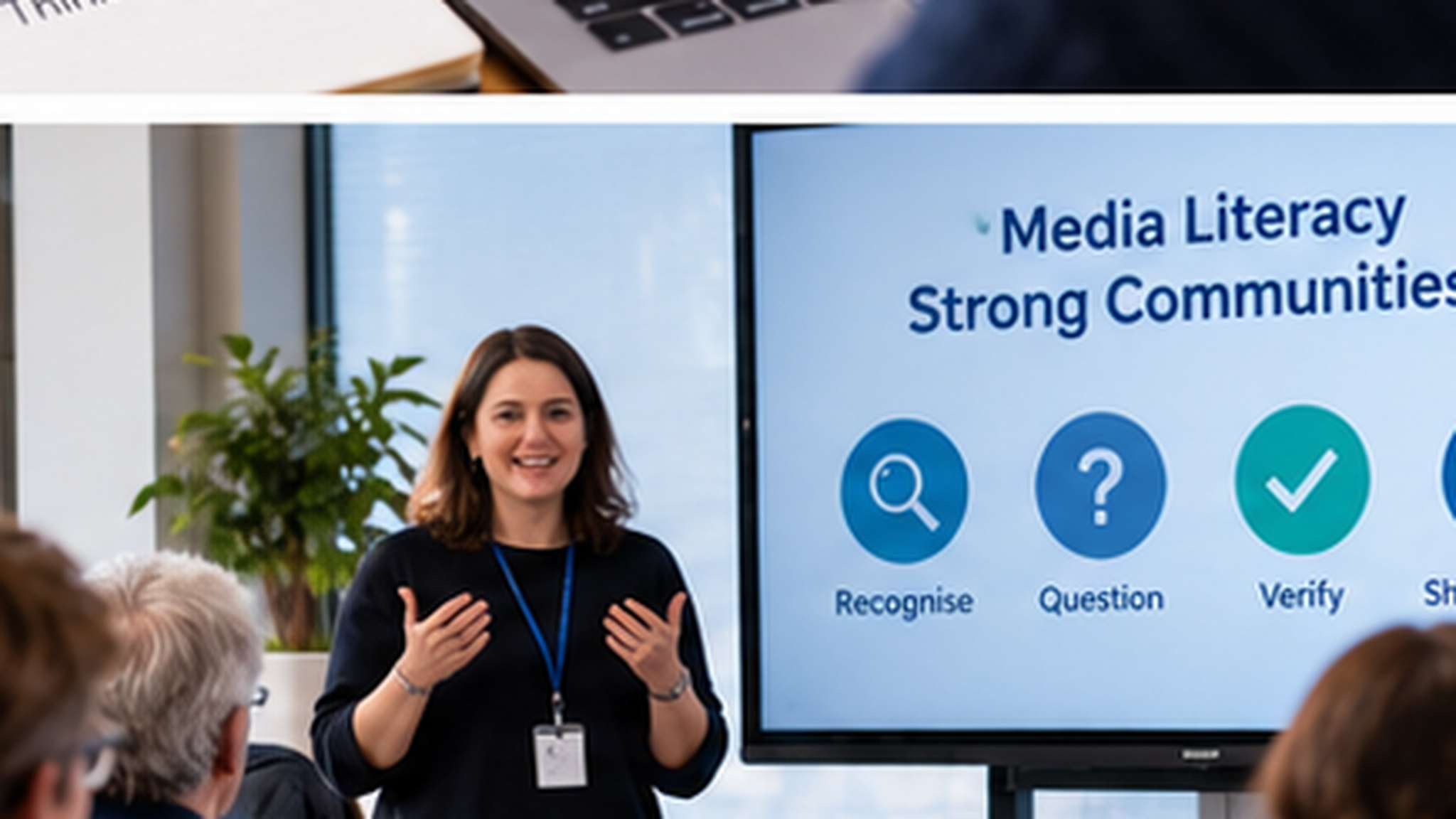
Media literacy does not require everyone to become a professional fact-checker. A useful workshop can begin with five questions:
-
Who is making the claim?
-
What is the original source?
-
Is there independent confirmation from a credible source?
-
Is the image, video or quote being presented in its original context?
-
What emotion is the post trying to trigger before you share it?
The last question is especially useful. Urgency, outrage, fear and tribal identity can make people share before checking. Generative AI can make fabricated material more convincing, but old-fashioned context checking still catches many problems.
A good rule is: pause, trace the claim to its source, and look for independent evidence before amplifying it.
What verification can — and cannot — solve
Identity verification can reduce some uncertainty online. Knowing that an account belongs to a verified person or business can make impersonation harder and provide more context about who is speaking.
But verified identity is not the same as verified truth. A real person can be mistaken. A verified business can publish an inaccurate claim. A genuine photograph can be paired with a false caption.
That distinction should be central to safer social platforms: establish who is behind an account where appropriate, then give users tools and habits to evaluate what the account says.
Where safegram fits — live, beta and planned
LIVE: Safegram is available on iOS and Android. Verification, social profiles and Safegram Exchange are part of the current platform direction, with verification required before businesses and creators add products or services to Exchange.
DEVELOPING / BETA: Safegram continues to develop and test discovery, marketplace, booking, messaging and AI-assisted experiences. Individual flows may change during rollout.
PLANNED / EXPANDING: Additional teen/family safeguards, age-aware contact boundaries, family notifications and automated safety signals remain part of the broader roadmap. They should not be described as universally deployed until marked live.
Safegram should also avoid claiming that a verification ring proves content is accurate. The stronger position is narrower and more credible: verified identity can add accountability, while media literacy helps users judge claims.

What an irish community group could build this week
For an eligible organisation considering the micro-fund, the strongest idea does not need to be technically complicated. It could be a free local workshop where participants bring suspicious posts and learn how to trace them; a practical session for parents and teenagers on AI-generated images; a programme for older people on impersonation and scam content; or a multilingual workshop for communities that are poorly served by mainstream media-literacy resources.
For the innovation strand, collaboration matters. A local organisation could pair its understanding of a community with a research, education or media partner capable of building a reusable programme or evaluating what works.
The deadline means applicants should use Coimisiún na Meán’s current guidelines and application forms rather than relying on summaries — including this article — for eligibility decisions.
The bigger idea: trust has to be learned, not assumed
The internet trained people to treat visual polish, follower counts and confident language as signals of credibility. Generative AI weakens those shortcuts further.
A safer digital culture needs better defaults from platforms, clearer accountability from publishers and stronger judgement from users. Ireland’s current funding call is modest in scale, but it points toward that wider model: invest in people as part of the safety system.
Frequently asked questions
What media-literacy funding is currently open in Ireland?
Coimisiún na Meán’s second 2026 call offers a total of €100,000 across a community Micro Fund and an Innovation Fund focused on countering disinformation through media literacy.
How much can a community organisation apply for?
Under Strand A, eligible community-based applicants can seek between €500 and €3,000.
How much is available for collaborative innovation projects?
Strand B offers grants up to €25,000 for consortia of two or more bodies working at regional or national level.
When is the deadline?
Applications close at 12 noon on 9 October 2026.
Do Strand A workshops have to be in Ireland?
Yes. Coimisiún na Meán states that in-person activities under the community strand must take place in Ireland and be free for participants.
Why is disinformation a priority now?
The European Commission’s 2026 Digital Decade survey found 87% of Europeans see online manipulation, including disinformation, foreign interference, AI-generated content and deepfakes, as a threat to democratic processes.
Does a verified account mean its posts are true?
No. Verification can help establish identity or account status, but the accuracy of individual claims still needs to be assessed on evidence.
Is Safegram receiving this funding?
This article makes no such claim. Safegram is reporting on the open funding opportunity and the wider importance of media literacy.
Source references
-
Coimisiún na Meán — Media Literacy & Countering Disinformation Micro Funds, published 3 September 2026.
-
Coimisiún na Meán — Media literacy funding: current Micro Fund and Innovation Fund guidance.
-
Coimisiún na Meán — Funding awarded to new Media Literacy & Countering Disinformation projects, 28 May 2026.
-
European Commission — Digital Decade 2026 Special Eurobarometer.
-
European Commission — Ireland’s 2026 Digital Decade country report.
-
Coimisiún na Meán — Media Skills and Development Fund to support fact-checking, 4 June 2026.
More from Safegram
Try Safegram
Privacy-first social and a verified marketplace, built in Dublin.