48 Hours Left: A Practical Guide to Ireland’s 2026 Media-Literacy Grants
Irish community groups have days left to apply for Coimisiún na Meán’s 2026 media-literacy and counter-disinformation funding.

Irish community organisations and collaborative teams have only days left to apply for Coimisiún na Meán’s current media-literacy and counter-disinformation funding. This practical guide turns the official call into a clear checklist — without replacing the scheme rules applicants must read before submitting.
With the 9 October deadline approaching, the strongest applications should connect a clearly defined audience, a practical learning activity and measurable outcomes.
Key takeaways
- Coimisiún na Meán has €100,000 available across its second 2026 media-literacy and counter-disinformation funding call.
- Strand A offers community micro-grants of €500–€3,000; Strand B offers up to €25,000 for collaborative regional or national projects.
- Applications close at 12 noon on Friday, 9 October 2026.
- A strong proposal should define the audience, the misinformation problem it addresses, the activity, expected outcomes and a realistic delivery plan.
- Applicants should use the regulator’s current guidelines and forms for eligibility and submission requirements; this article is a practical explainer, not the official application rules.

The deadline is now the story
Ireland’s current media-literacy funding call is no longer a distant opportunity. With applications closing at 12 noon on 9 October, organisations considering a submission are in the final preparation window.
Coimisiún na Meán opened the second 2026 call on 3 September under Ireland’s National Counter Disinformation Strategy. The regulator says €100,000 is available for initiatives that strengthen media literacy and help people recognise and respond to disinformation.
The policy context is significant. The European Commission’s 2026 Digital Decade research found that 87% of Europeans view online manipulation — including disinformation, foreign interference, AI-generated content and deepfakes — as a threat to democratic processes. Ireland’s 2026 country reporting also found very high public priority for online privacy, safety and digital skills.
First, choose the right funding strand
Strand A is the Media Literacy Countering Disinformation Micro Fund. It offers €500 to €3,000 for community-based activity. Coimisiún na Meán says in-person activity under this strand must take place in Ireland and be free to participants.
Strand B is the Innovation Fund. It is intended for a consortium of two or more bodies and can support projects up to €25,000 at regional or national level.
The practical difference is scale. A local workshop series for parents, teenagers or older people may fit the micro-fund. A reusable programme, research-led intervention or cross-organisation initiative with wider reach may be more appropriate for the innovation strand.
Useful projects can be simple and practical: workshops that teach people how to identify a claim, trace its source, verify evidence and share responsibly.
Five questions a good application should answer
-
Who exactly are you helping? “The public” is broad. A defined group — teenagers, parents, older adults, local volunteers, multilingual communities or small-business owners — makes the need easier to understand.
-
What problem are you solving? Name the behaviour or knowledge gap: difficulty recognising manipulated images, confusion about source credibility, scam-style impersonation, or uncertainty about AI-generated content.
-
What will participants actually do? Describe the workshop, training, pilot, event, research or learning activity in concrete terms.
-
What changes if the project works? Useful outcomes can include improved source-checking confidence, stronger understanding of manipulated media, or a tested resource that another community can reuse.
-
Can you deliver it with the time, people and budget available? A modest plan that can be executed is more credible than an ambitious concept without a delivery path.
A simple workshop model
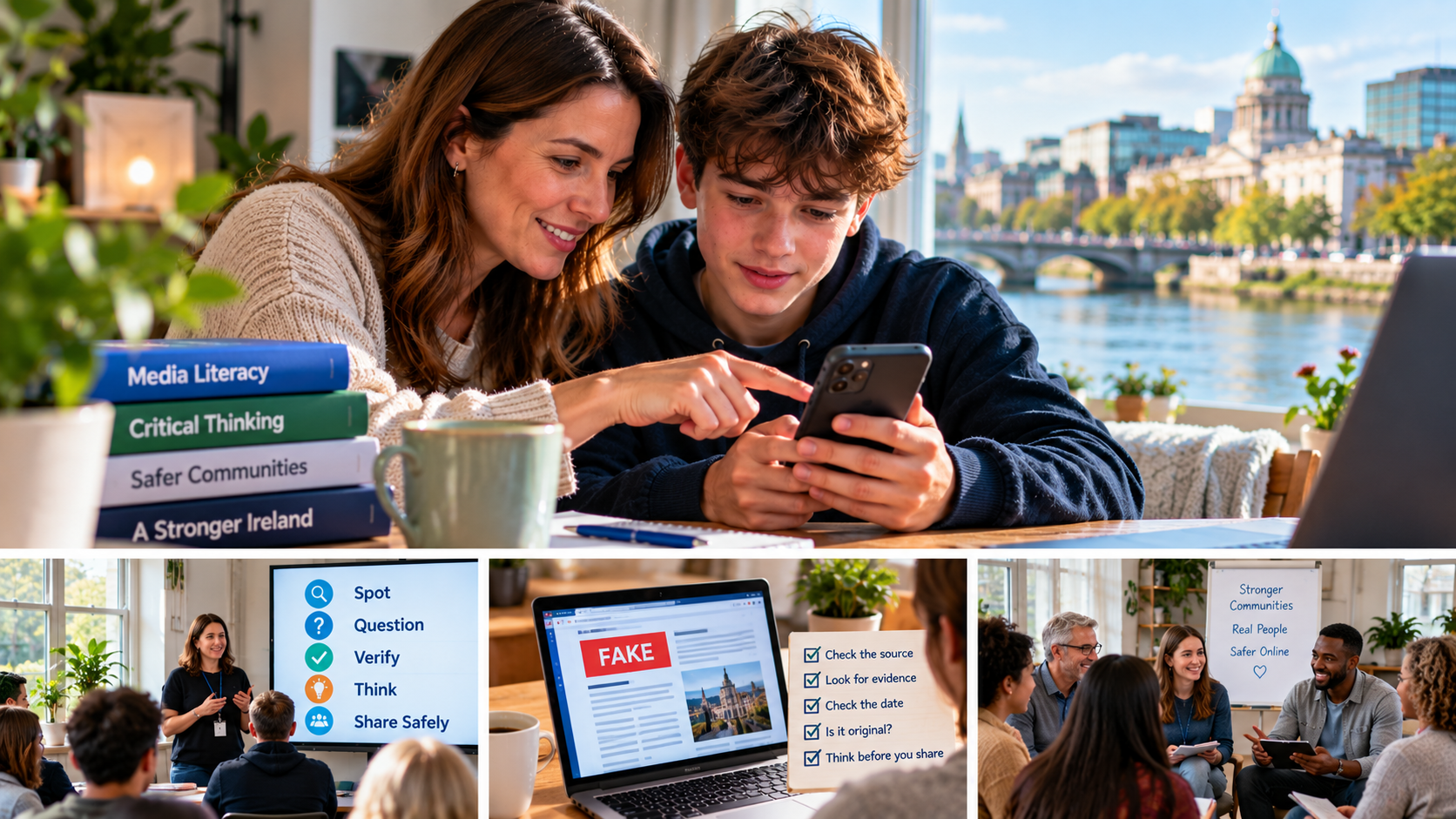
One practical format is a “pause, trace, verify” session. Participants bring examples of questionable posts. The facilitator asks them to identify the original claim, locate the earliest available source, look for independent evidence, inspect whether images or quotes are being used in context, and discuss what emotional trigger encouraged the content to spread.
This approach does not require participants to become professional fact-checkers. It teaches a repeatable habit that can travel home with them.
A repeatable verification habit — check the source, evidence, date and original context before sharing — can make media literacy useful beyond a single workshop.
Don’t confuse identity verification with fact-checking
A verified identity can add accountability online, but it cannot prove that every claim made by that person or business is accurate. Real people can be mistaken, and genuine images can be paired with false captions.
That distinction matters for Safegram. The platform’s verification direction is intended to provide more context about who is behind an account or business. It should not be marketed as a guarantee that every post is true.
Where safegram fits — live, developing and planned
LIVE: Safegram is available on iOS and Android. Verification, social profiles and Safegram Exchange form part of the current platform, and businesses and creators must be verified before adding products or services to Exchange.
DEVELOPING / BETA: Safegram continues to develop and test discovery, marketplace, booking, messaging and AI-assisted experiences. Individual flows may change during rollout.
PLANNED / EXPANDING: Additional teen and family safeguards, age-aware contact boundaries, family notifications and automated safety signals remain part of the broader roadmap. They should not be described as universally deployed until they are marked live.
Safegram is not claiming to receive this media-literacy funding. The relevant connection is the wider trust model: platform design can establish more context and accountability, while users still need the skills to assess what they see.
The 48-hour application checklist
- Download the current official guidelines and application form from Coimisiún na Meán.
- Confirm that the organisation and proposed activity fit the chosen strand.
- Write one clear sentence defining the audience and the problem.
- Describe the activity in practical terms and connect each cost to delivery.
- Set two or three measurable outcomes.
- Check partner responsibilities if applying as a consortium.
- Review the form against the official eligibility and submission requirements.
- Submit before 12 noon on 9 October rather than relying on a last-minute upload.
Why this matters after the deadline
The funding window will close, but the underlying problem will not. Generative AI makes convincing synthetic content cheaper to create, while social platforms can move claims through communities faster than traditional correction mechanisms can respond.
A durable safety model therefore needs both sides: better platform safeguards and stronger human judgement. Media literacy is not a substitute for platform responsibility, and platform moderation is not a substitute for public understanding.
The most useful projects will make verification a normal habit rather than a specialist skill.
Frequently asked questions
When does the current Irish media-literacy funding call close?
Applications close at 12 noon on Friday, 9 October 2026.
How much is available?
Coimisiún na Meán says €100,000 is available across the second 2026 call.
How much can a community group apply for?
Under Strand A, eligible applicants can seek between €500 and €3,000.
How much can a collaborative project receive?
Strand B can provide up to €25,000 for a consortium of two or more bodies working at regional or national level.
Do community-strand events need to be free?
Yes. The regulator states that in-person activities under Strand A must take place in Ireland and be free to participants.
What kinds of projects can work?
The official call points to activities such as workshops, training, events, pilot programmes and research, subject to the scheme rules.
Does Safegram receive this funding?
This article makes no such claim. Safegram News is reporting on the opportunity and the wider issue of digital trust.
Does Safegram verification prove a post is true?
No. Verification can provide identity or account context; the truth of a specific claim still depends on evidence.
Source references
-
Coimisiún na Meán — Media Literacy & Countering Disinformation Micro Funds, 3 September 2026.
-
Coimisiún na Meán — current Media Literacy Countering Disinformation Micro Fund and Innovation Fund guidance.
-
European Commission — Digital Decade 2026 Special Eurobarometer.
-
European Commission — Ireland 2026 Digital Decade country reporting.
-
European Commission — EU KIDS Act proposal, 17 September 2026, updated 5 October 2026.
More from Safegram
Try Safegram
Privacy-first social and a verified marketplace, built in Dublin.