
Ireland’s Online Safety Debate Is Moving Beyond Bans — and Children Are Asking to Be Taught, Not Shut Out
New Irish research suggests children prefer online safety education over social media bans, prompting regulators to focus on age assurance, parental controls, and privacy-preserving age verification.
Ireland’s argument about children and social media is entering a more evidence-led phase. Fresh national research says most children would rather learn how to stay safe online than simply be banned. Meanwhile, regulators are testing whether platforms’ age-assurance and parental-control systems actually work, and Europe is developing ways to prove age without exposing unnecessary identity data. The harder question is no longer whether children face online risks. It is what a credible, rights-respecting safety system should look like.
Key takeaways
- Coimisiún na Meán’s new Irish research says the majority of children surveyed favour online-safety education over a social-media ban.
- Parents and caregivers are more divided, but 43% agreed that a ban would not be effective because children could circumvent it, compared with 23% who disagreed.
- Ireland’s first formal investigation under the Online Safety Code, opened on 8 September, concerns potential ineffective age assurance and parental controls on X. This is an investigation, not a finding of breach.
- The European Commission is urging Member States to roll out privacy-preserving age verification that can prove an age threshold without revealing exact age, identity or other personal details.
- The strongest policy response is likely to combine digital literacy, age-appropriate product design, enforceable platform duties, parental tools and privacy-preserving age assurance rather than relying on one measure alone.
A new irish data point changes the debate
For years, the debate around children and social media has often collapsed into two opposing positions: let young people use mainstream platforms largely as they do now, or keep them off those platforms until a fixed age.
The latest Irish evidence suggests children themselves see a third path.
On 10 September, Coimisiún na Meán published “Online Safety & Children’s Digital Lives”, Ireland’s country research within the wider EU Kids Online study. Its headline finding is striking: the majority of children surveyed think it would be better to teach them how to stay safe online than ban them from social media.
That does not mean children believe the internet is harmless. It means many appear to distinguish between risk and prohibition. Digital life is already part of friendship, entertainment, learning, identity and culture. A policy that acknowledges that reality may have a better chance of changing behaviour than one young people believe they can simply work around.
Parents are understandably more cautious. Yet the regulator reports that parents and caregivers were more likely to agree (43%) than disagree (23%) that a ban would not be effective because children would circumvent it. Children, too, largely agreed that young people would find a way around a ban.
That finding should not be read as proof that age limits are useless. It should be read as a warning against treating an age threshold as a complete safety strategy.
Education is not a substitute for platform responsibility
There is an obvious danger in saying “teach children to be safe”: responsibility can quietly move from the companies designing powerful digital systems onto children, parents and schools.
That would be the wrong lesson.
Media literacy matters because young people need practical skills: recognising manipulation, understanding recommendation systems, questioning synthetic or AI-generated content, protecting personal information, handling unwanted contact and knowing when and how to report something.
But education works best when the environment itself is safer. A child should not need expert-level digital literacy to avoid product choices that unnecessarily expose them to harmful content, adult contact or intrusive data practices.
This is why Ireland’s Online Safety Framework and the EU Digital Services Act matter. They shift part of the burden upstream, toward the systems and processes operated by platforms.
Ireland has now moved from rules to an investigation
On 8 September 2026, Coimisiún na Meán opened the first formal investigation under Ireland’s Online Safety Code. The investigation concerns X and potential ineffective implementation of age-assurance mechanisms, as well as concerns about parental-control systems.
The distinction is important: opening an investigation does not establish that X has breached the Code. The regulator will investigate the concerns through its formal process.
According to Coimisiún na Meán, age assurance is required on X to ensure children do not see videos depicting pornography or extreme or gratuitous violence or cruelty. The regulator also says that because X allows adult-only content while allowing under-16s to use the service, parental-control requirements apply.
This is where online-safety policy becomes concrete. A platform can have an age rule in its terms, but the meaningful question is whether its systems reliably support that rule and reduce children’s exposure to inappropriate material.
Age assurance does not have to mean showing every platform your identity

Effective family safety starts with practical conversations and understandable controls, not continuous surveillance.
Privacy is one of the strongest objections raised when governments discuss age verification. If badly designed, an age-checking system could create new databases, encourage unnecessary identity collection or make people reveal more information than a service actually needs.
Europe is explicitly trying to avoid that model.
The European Commission’s age-verification blueprint is designed so a user can prove that they meet an age threshold without revealing their exact age, identity or other personal details to the online service. In April, the Commission urged Member States to accelerate rollout of the solution by the end of 2026.
That principle matters beyond adult-only services. The Commission says the technology can be adapted to other thresholds, such as 13+.
The design lesson is simple: a service often needs to know “is this person old enough for this experience?” rather than “who exactly is this person?” Those are very different data requests.
A privacy-preserving proof can therefore support two goals that are too often presented as opposites: stronger protection for minors and less unnecessary disclosure of personal identity.
What parents actually need
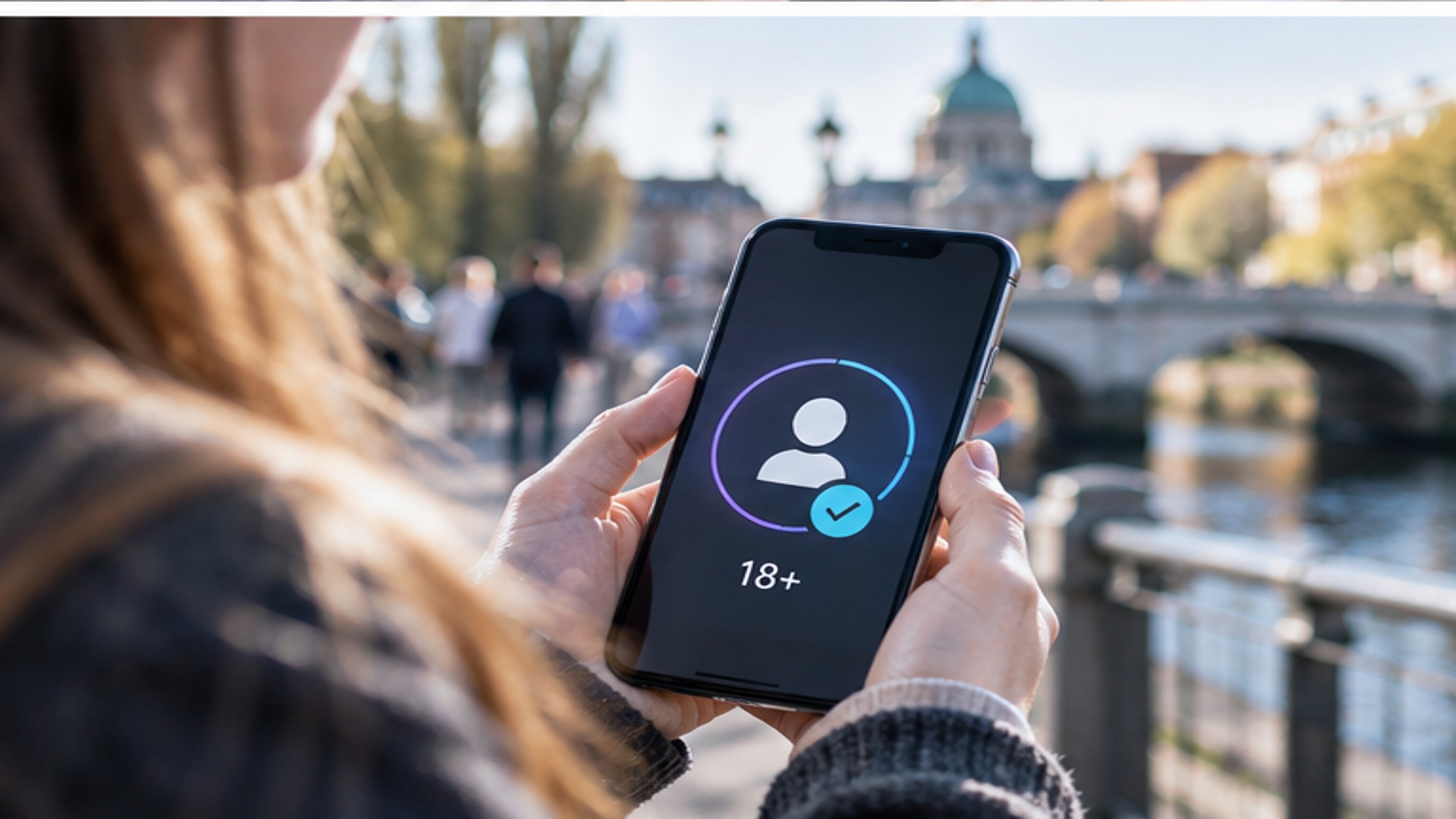
The EU’s emerging model aims to prove an age threshold without revealing unnecessary identity information to the online service.
Parents are frequently told to supervise children online, but supervision becomes unrealistic if it assumes adults can continuously inspect every message, video, algorithmic recommendation and emerging app.
Better parental safety design should make the important things understandable: what protections are active, which experiences are age-restricted, how contact settings work, how to report problems and where to get help.
It should also respect young people’s legitimate need for privacy. Safety does not automatically require parents to read every private conversation. Good systems can create boundaries, alerts and age-appropriate defaults without turning family safety into permanent surveillance.
The new Irish research reinforces the value of conversation. If children believe education is more useful than blanket exclusion, parents and schools have an opportunity to move beyond “don’t use this” toward practical discussions about what young people actually encounter online.
Media literacy is becoming infrastructure

Media literacy increasingly includes algorithms, AI-generated content, privacy, online contact and the ability to question persuasive digital systems.
The case for digital literacy is also expanding because social media is no longer only social media. Young people now encounter AI chatbots, synthetic images, recommender systems, creators, advertising, marketplaces and private messaging inside overlapping digital environments.
The skill set therefore needs to be broader than recognising a suspicious website. Children need to understand why a feed may repeatedly show a certain type of content, why an AI answer can sound confident and still be wrong, why identity and age claims online may be unreliable, and why emotional pressure is often a warning sign.
Ireland is investing more broadly in media literacy and counter-disinformation initiatives. Coimisiún na Meán’s September funding call notes that €1.1 million was allocated in Budget 2026 to support implementation of the National Counter Disinformation Strategy through initiatives including research, media literacy and fact-checking.
For schools, parents and youth organisations, that makes media literacy less like an optional lesson and more like civic infrastructure for growing up online.
What this means for safegram
Safegram’s direction is relevant to this debate, but product claims need to remain precise.
Safegram is building around verified participation, privacy-conscious communication and stronger age-based safety boundaries. Its product direction includes separating teen interactions from older users, limiting adult discovery or messaging of teen accounts, and family-safety mechanisms designed to provide safety signals without giving family members access to private message content.
Those safeguards should be described according to their actual release state in the product at the time of publication. Features that are still being implemented or tested should be labelled beta or planned rather than presented as universally live.
The broader design principle is more important than any single feature: verification should not automatically require a person to publicly expose their real-world identity. A platform can verify eligibility or authenticity while allowing the public-facing profile to remain appropriately private or pseudonymous, provided safety rules and legal obligations are still enforced.
That approach aligns with the direction of privacy-preserving age assurance in Europe: verify what is necessary for safety, but do not disclose more personal information than the interaction requires.
Beyond “ban or no ban”
Ireland does not need to choose between pretending online harms are manageable through education alone and treating exclusion as the only serious safety measure.
A more credible model has several layers.
Children need education that reflects the digital environments they actually use. Parents need usable controls and clear information. Platforms need age-appropriate defaults and effective reporting and contact protections. Regulators need enforceable standards. Age assurance needs to work without becoming an excuse for unnecessary identity collection.
And children need a voice in the systems designed for them.
The newest Irish research is valuable precisely because it asks young people what they think. Their answer is not that safety is unnecessary. It is that they want the skills to navigate digital life.
The challenge for Ireland is to make sure those skills are matched by platforms worthy of that trust.
Frequently asked questions
Is Ireland banning social media for children?
There is an active policy debate about children’s access to social media, but the new Coimisiún na Meán research is evidence about attitudes rather than an announcement of a new blanket ban. The report says most children surveyed favour online-safety education over a ban.
What do Irish children think about a social-media ban?
Coimisiún na Meán says the majority of children surveyed think teaching them to stay safe online would be better than banning them from social media. The majority also agreed that children would find ways around a ban.
What do Irish parents think?
Parents and caregivers are more divided. Coimisiún na Meán reports that 43% agreed a ban would not be effective because children would circumvent it, while 23% disagreed.
What is age assurance?
Age assurance is a broad term for methods used to establish or estimate whether a user falls within an age range or meets an age threshold. Different methods can have very different implications for accuracy, privacy and data protection.
Can age verification protect privacy?
Yes, depending on the system. The EU blueprint is specifically designed to let a user prove an age threshold without revealing exact age, identity or other personal details to the online service.
Why is X being investigated in Ireland?
Coimisiún na Meán opened an investigation on 8 September into concerns about potential ineffective implementation of age assurance and parental controls under Ireland’s Online Safety Code. An investigation is not a finding that a breach occurred.
Is online-safety education enough on its own?
No. Education can strengthen children’s skills, but platform design, parental tools, age-appropriate protections, effective reporting systems and regulatory enforcement also matter.
How does this relate to Safegram?
Safegram’s product direction emphasises verified participation, privacy and age-based safety boundaries. Any specific safeguard should be described as live, beta or planned according to its actual deployment status when the article is published.
More from Safegram
Try Safegram
Privacy-first social and a verified marketplace, built in Dublin.