Safegram News | Article 54 | Meta Paused Its Crawling Terms | Updated 30 October 2026
Meta’s crawling terms rollout is paused: what businesses should know about content rights, crawler access and separate AI search and training controls.
- The proposed rollout is paused; the CMA investigation is not a verdict. [1]
- Copyright ownership, client permissions, platform terms and crawler access answer different questions.
- Search visibility and AI-model training are not interchangeable. Some providers offer separate controls. [3][4]
- A clear service listing should explain what the buyer receives, what reuse is permitted and what remains outside the agreement.
What changed in Meta’s commercial terms story?
The original 30 October start date was moved to 20 November. Meta then announced a pause on 28 October while consulting industry groups. The CMA is examining dominance and potentially unfair trading conditions under the UK Competition Act 1998. Its concern involves content from business and publisher websites being used in Meta’s own products, including AI features, without meaningful choice. [1]
Meta rejects the interpretation that the proposed terms give it unlimited rights to publishers’ content. Reuters reported on 28 October that the company would consult industry groups and that existing terms would remain in effect in the meantime. [2]
This is a UK competition case, not a new EU-wide copyright ruling or a US judgment. Businesses in Ireland, other EU countries and the United States should check the terms applying to their accounts rather than assume a single headline resolves their local legal position. The published announcement does not establish what any particular model was trained on.
One piece of content can have four different permission questions
Consider an illustrative example: a Dublin ceramics shop commissions a creator to film a product demonstration. The creator delivers a vertical video, the shop posts it on Instagram, and the same video appears on the shop’s website. One production now touches a client agreement, a platform agreement and a website.
Start with ownership. Ireland’s Intellectual Property Office explains that copyright protects original works, including photographs and films, and gives rights holders control over specified uses, subject to legal exceptions. Publishing a work and permitting a particular use are not the same as transferring every right in it. The contract and the applicable law still need to be read together. [5]
Who can use the finished work?
For the ceramics campaign, the brief should distinguish the finished video from raw footage, organic posts from paid advertisements, and a short campaign from an open-ended licence. State the permitted channels, territory, duration and editing rights. Discuss AI-related reuse explicitly instead of assuming that a broad word such as “digital” settles it. These are negotiation questions, not a universal legal template.
Who can access the website?
A crawler is an automated client that requests online resources. A website’s robots.txt file communicates rules to cooperating crawlers; the Robots Exclusion Protocol expressly says those rules are not access authorisation. Password protection and other access controls—not a robots.txt entry—belong around confidential material. [6]
That gives the business four useful headings for its records: ownership of the asset, the client’s licence, the platform’s terms and the website’s access settings. Keep the dated agreement and the person responsible for each. A technical setting should never be mistaken for a complete answer to a contractual dispute.
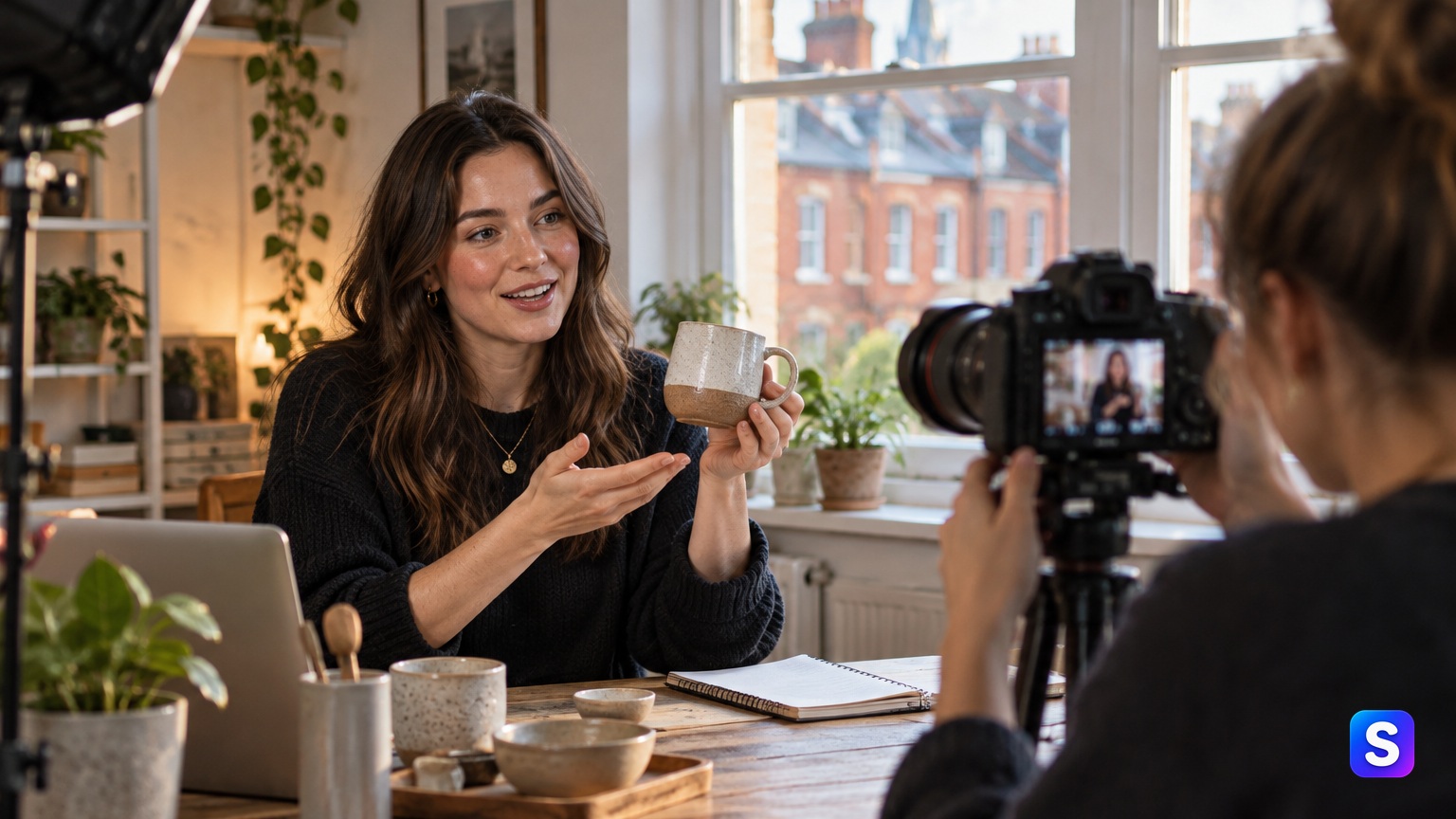
AI-generated editorial illustration: a creator’s deliverable and the client’s permission to reuse it should be agreed separately. This is not a photograph of a named campaign or client.
Can you appear in AI search without opening every training door?
Sometimes—but there is no universal switch. OpenAI documents separate robots.txt controls for OAI-SearchBot, which supports search, and GPTBot, which concerns content that may be used in model training. A site can allow one while disallowing the other. The company also recommends allowing the published searchbot IP ranges; a permissive robots.txt file will not solve a separate hosting or firewall block. [3]
Google’s controls are different. Its documentation says Google-Extended governs certain Gemini training and grounding uses; it does not determine inclusion or ranking in Google Search. Because grounding is also covered, blocking it is not accurately described as “training only”. Googlebot remains relevant to Google Search and its features. [4]
For a business owner, the practical question is therefore “Which service, for which purpose?” rather than simply “Should we allow AI?” Ask a webmaster to map the relevant providers’ documented controls before making a change. Keep valuable public service information discoverable, protect private material properly, and make the separate reuse decision deliberately.
Visibility still depends on useful, accessible pages
Google says its established SEO practices remain relevant to AI Overviews and AI Mode; there is no special additional markup required for those features. The foundations are understandable pages that can be crawled and indexed, useful text, internal links and structured data that matches what readers can see. None guarantees selection. [7]
The editorial implication is straightforward. An answer that explains a service accurately is more useful than a page repeating “best creator marketplace” in six languages. A comparison needs evidence. A pricing page needs real prices. An author or business identity needs consistency. Content should make a decision easier for a human before anyone attempts to optimise it for a machine.
A creator marketplace needs clear permissions as well as clear identities
Now return to the ceramics example. A buyer should be able to understand who made the video, what service is being offered and which uses are included before a purchase or commission. Identity and scope work together; neither replaces the other.
Safegram’s approach combines creator and business profiles with Exchange listings, making the distinction relevant inside social commerce itself. Its published trust guidance describes verification as a signal—not a guarantee of behaviour or outcome. A creator’s identity check does not establish ownership of every image in a portfolio, and it does not grant a customer additional copyright permissions. [8]
A useful listing could say, for example, “One edited product demonstration; one revision; organic use on the client’s named channels for an agreed period.” That wording is illustrative, not a Safegram package or price. Paid advertising, raw files and other uses should be discussed separately where they fall outside the agreed scope.
The same standard should apply on any platform. Established social networks can be valuable distribution channels; adding a professional portfolio or another marketplace is not a reason to abandon an effective audience. The more durable strategy is to preserve the original files, understand each permission and avoid making one account the only route through which a customer can reach the business.

AI-generated editorial illustration: an independent retailer reviews its digital presence. Discoverability and control should be considered together, not traded away by default.
Five checks before the next campaign goes live
- Write down the offer. Define the deliverable, turnaround, revisions and permitted uses before production begins. Keep sample work clearly labelled; do not imply an invented client relationship.
- Save the relevant terms. Record which account and service they cover, the version or date, and who approved them. Recheck after an announced change rather than relying on an old screenshot.
- Audit the public/private boundary. Keep confidential briefs, identification documents and unpublished customer material behind genuine access controls. A crawler instruction is not a privacy barrier. [6]
- Separate discovery from reuse. Review search, previews, AI answers and model-training controls provider by provider. Document the owner’s decision and test the public pages after any change.
- Keep a route to the customer. Maintain accurate business details, an accessible portfolio and clear enquiries. Measure qualified enquiries or completed orders, not impressions alone; do not claim results that have not been measured.
The better question is not “How do we block everything?”
For creators, discoverability and control are both commercial assets. A searchable portfolio can help a customer find the right person. A clear licence can help that same person build a sustainable business. Treating either as an afterthought makes the relationship harder to manage.
The useful response to the Meta dispute is neither panic nor blind acceptance. It is a repeatable habit: know what you own, know what you have agreed, and know which systems can access what you publish. A platform’s promise is more credible when its rules and its actual behaviour can be checked.
Frequently asked questions
Are Meta’s new commercial terms already in force?
The disputed rollout is paused as of this update. Do not treat the former October deadline as a current requirement. Check your account notices for subsequent changes. [1][2]
Does the CMA investigation mean Meta broke the law?
No. Opening an investigation is not an infringement finding. [1]
Does robots.txt protect private files?
No. It communicates crawler rules but is not access authorisation. Use appropriate authentication and security controls for private material. [6]
Can I allow ChatGPT search while restricting OpenAI training?
OpenAI documents independent controls for OAI-SearchBot and GPTBot. Correct settings do not guarantee that an answer will feature your page. [3]
What should a UGC creator put in a usage agreement?
Define the assets, channels, duration, territory, advertising use, editing, raw-file delivery and any agreed AI-related reuse. Obtain qualified advice for valuable or disputed rights; the applicable law and contract matter.
Does a verified profile prove ownership of a portfolio?
No. Identity verification and permission to use creative work are separate questions. Ask for evidence appropriate to the commission, and keep the agreement with the brief.
Put the next brief in writing
Before sending the next campaign, ask: “Who owns this work, and what exactly are we authorising?” Creators exploring Safegram can show their work and describe their services clearly; buyers should ask about deliverables and usage rights before agreeing a commission. Explore Safegram at https://safegram.com/for-creators and its explanation of trust signals at https://safegram.com/trust .
This article is general information and editorial analysis, not individual legal advice. Safegram News is published by Safegram; product descriptions are not an independent audit of the platform.
Sources and references
[1] Competition and Markets Authority, 30 October 2026: investigation and rollout status
https://www.gov.uk/government/news/cma-opens-investigation-into-metas-commercial-terms--2
[2] Reuters, 28 October 2026: Meta’s response and consultation
[3] OpenAI: Overview of OpenAI Crawlers
https://developers.openai.com/api/docs/bots
[4] Google: common crawlers, including Googlebot and Google-Extended
https://developers.google.com/crawling/docs/crawlers-fetchers/google-common-crawlers
[5] Intellectual Property Office of Ireland: What is Copyright?
https://www.ipoi.gov.ie/en/types-of-ip/copyright1/understanding-copyright/what-is-copyright/
[6] IETF / RFC Editor: RFC 9309, Robots Exclusion Protocol
https://www.rfc-editor.org/rfc/rfc9309.html
[7] Google Search Central: AI features and your website
https://developers.google.com/search/docs/appearance/ai-features
[8] Safegram: Trust signals, not guarantees (company description)
Verification: sources checked 30 October 2026. Meta’s live legal page redirected to login and its preview could not be fetched in this session; the current pause and investigation status are grounded in the CMA announcement, with Meta’s response attributed to Reuters. No claim is made that the complete current contract has been independently inspected.
Publisher pack — not part of the article body
SEO title: Meta Crawling Terms: Content Rights and AI Visibility
Meta description: Meta’s crawling-terms rollout is paused. What creators and businesses should check about content rights, robots.txt and visibility in AI search.
Suggested slug: meta-commercial-terms-ai-crawling-content-rights. Keep an existing published URL if one exists; do not create a duplicate or change a live slug without an approved redirect.
Primary intent: understand the current Meta commercial-terms dispute and take practical steps to manage content rights and crawler access. Secondary entities: AI crawling; robots.txt; UGC creator usage rights; copyright ownership; OAI-SearchBot and GPTBot; Google-Extended.
Semrush evidence, retrieved 30 October 2026: US meta commercial terms 20 estimated monthly searches (difficulty 0 with absent intent; not evidence of easy ranking); AI crawling 50 / KD33; content rights 50 / KD16; robots.txt 6,600 / KD84. Ireland robots.txt 140 / KD77 and content rights 20 (reported difficulty 0, absent intent). UK meta commercial terms 20; AI crawling 10. Low-volume timely coverage is chosen for relevance, not promised traffic. Do not add unrelated high-volume phrases to this article.
Internal links: /for-creators for creator services; /trust for verification limitations; /guides/social-media-alternatives for channel diversification. These English routes were checked in the connected-site audit. Do not link to /fr/for-creators, /de/for-creators or /es/for-creators until actual translated routes exist.
Publication: preserve the real first-publication date if the article is already live and use 30 October 2026 as the genuine update date for this rewrite. “First prepared” in this Doc is not proof of website publication. Use Article or NewsArticle structured data matching the visible headline, byline, dates and actual published images. No ratings or invented URLs. Keep FAQ content visible; rich-result display is not guaranteed. Do not deploy site changes without approval.
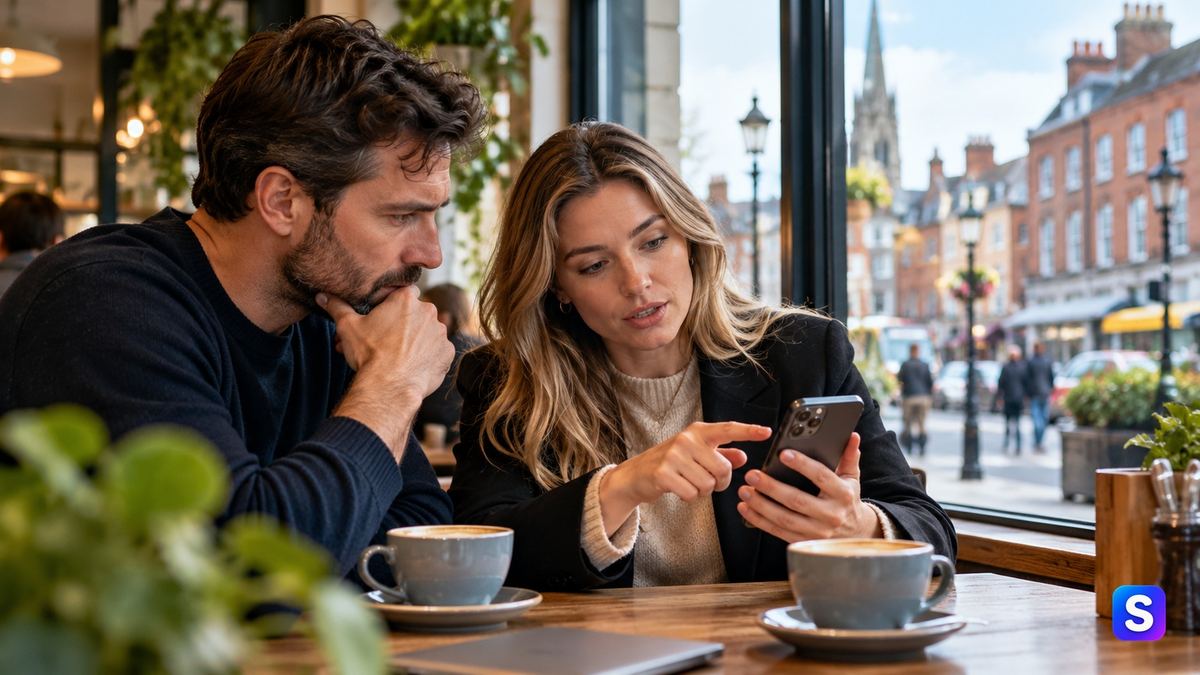
Image 1: safegram-meta-crawling-terms-hero.jpg. Alt: Two adults discussing information on a smartphone at a café table, with an official Safegram icon. Caption appears near the opening.
Image 2: safegram-ugc-content-rights.jpg. Alt: A content creator demonstrating a ceramic mug to a camera in a home studio, with an official Safegram icon. Caption appears in the rights section.
Image 3: safegram-local-business-digital-control.jpg. Alt: Two people reviewing a laptop at an independent clothing shop counter, with an official Safegram icon. Caption appears before the practical checks.
Visual disclosure: all three scenes are AI-generated editorial illustrations reused from the existing article asset collection; they depict no named real clients, employees or events. The exact supplied Safegram logo is composited proportionately on each image. No generated logos or invented app interfaces are used.
LinkedIn copy: Your content needs to be discoverable. That does not make every reuse the same decision. With Meta’s proposed commercial terms paused and the CMA investigating, we explain the difference between ownership, licences, crawler access and AI search. For creators and businesses, the first step is practical: know what you have agreed before the next campaign goes live. #Safegram #CreatorEconomy #DigitalRights #AI #SmallBusiness
Localization briefs, not published translations: FR — “Conditions Meta : droits sur les contenus et visibilité dans la recherche IA”; DE — “Meta-Crawling: Inhaltsrechte und Sichtbarkeit in der KI-Suche”; ES — “Condiciones de Meta: derechos del contenido y visibilidad en búsquedas con IA”. Research each market and translate the full body, FAQ, metadata and navigation before publishing. Obtain fluent editorial review and use reciprocal hreflang only for live equivalent pages.
More from Safegram
Try Safegram
Privacy-first social and a verified marketplace, built in Dublin.