
Ireland Has Marketplaces for Everything. Safegram Wants to Be the Trust Layer Between Them
Safegram aims to connect Ireland’s fragmented marketplaces through verified identity, local discovery and social commerce.

Ireland already has powerful digital marketplaces. Daft has extraordinary property reach. Treatwell has built a specialist beauty-booking network. DoneDeal has scale in classifieds and motors. Facebook and Instagram dominate social discovery. Bark and Tradesmen.ie connect customers with service professionals. Safegram’s investment thesis is not that all of those products are weak. It is that the customer journey is fragmented — and that verified identity, social discovery, local community and commerce can become more valuable when they live together.
Key takeaways
- Ireland is one of Europe’s strongest digital-commerce markets: 37% of Irish businesses conduct e-sales and 38% of business turnover comes from e-sales, the highest share in the EU.
- Irish consumers also place unusually high value on digital trust: 97% say protecting online privacy and security should be a priority, while 97% support stronger online protection for children and young people.
- Existing leaders prove that Irish consumers already embrace specialist digital marketplaces: Daft in property, Treatwell in beauty and wellness, DoneDeal in classifieds and motors, and service platforms such as Bark and Tradesmen.ie in professional leads.
- Meta proves the power of social discovery, messaging and creator-led commerce, but the commercial journey can remain fragmented across profiles, messages, ads, external links and separate transaction systems.
- Safegram’s differentiation is not simply another feed or another listings site. It is one verified identity layer across social discovery, businesses, creators, Exchange, Plans, Circles, encrypted chat, offers and local commerce.
- Every Safegram business, creator and seller must complete verification before listing commercially.
- Safegram is early. It does not yet have the liquidity, inventory or audience scale of Ireland’s established marketplaces. The €250,000 investment thesis is to prove that the integrated model can build density, retention and paid commercial activity in Ireland.
- The strongest investor case is therefore not “Safegram is better than every incumbent.” It is “Safegram is designed to solve a different layer of the market: trusted cross-category discovery and commerce.”
THE MARKET IS NOT EMPTY. THAT IS THE OPPORTUNITY.
A weak startup thesis begins by pretending competitors do not exist.
A stronger one asks what successful incumbents have already proved.
Daft proves that Irish consumers will build a habit around a high-intent specialist marketplace. Its own company information describes Daft as Ireland’s number-one property website and app, with more than 2.5 million users each month and roughly 70,000 properties for sale or rent listed at any one time.
Treatwell proves that bookings can become a repeat digital habit in a specialist vertical. It describes itself as Europe’s largest hair and beauty booking website, with more than 75,000 local partners.
DoneDeal proves that Irish users will buy and sell across a large classifieds ecosystem. The company describes itself as Ireland’s largest classifieds website, with particular strength in cars, motors and general merchandise.
Facebook Marketplace proves that local commerce benefits from an existing social graph. Instagram proves that creators and small businesses can turn attention into messages, leads and sales.
Bark and Tradesmen.ie prove that consumers are willing to submit service needs online and be matched with professionals.
Those are not reasons for Safegram to stay out of the market.
They are evidence that the market already exists.
The strategic question is what remains fragmented between those experiences.

One person, five digital journeys
Imagine a normal week for one person in Dublin.
They search Daft for an apartment.
They book a haircut through Treatwell.
They look for a used item on DoneDeal or Facebook Marketplace.
They ask friends on Instagram for a restaurant recommendation.
They use Bark or Tradesmen.ie to find someone for a home-improvement job.
Each platform can be excellent at its specialist job.
But the consumer repeatedly starts again.
A different profile.
A different reputation system.
A different message thread.
A different payment or booking flow.
A different definition of trust.
A different business relationship.
That fragmentation is the space Safegram is targeting.
Safegram is not trying to become a better property-search engine than Daft overnight, a deeper salon-management system than Treatwell, or a larger classifieds inventory than DoneDeal.
Its thesis is different:
What if a person could discover a local business socially, see that the seller or business is verified, view its products or services, message privately, join a related community, book or buy, and continue following that relationship — without rebuilding trust from zero in another product?
That is a platform-level opportunity rather than a single-category marketplace opportunity.
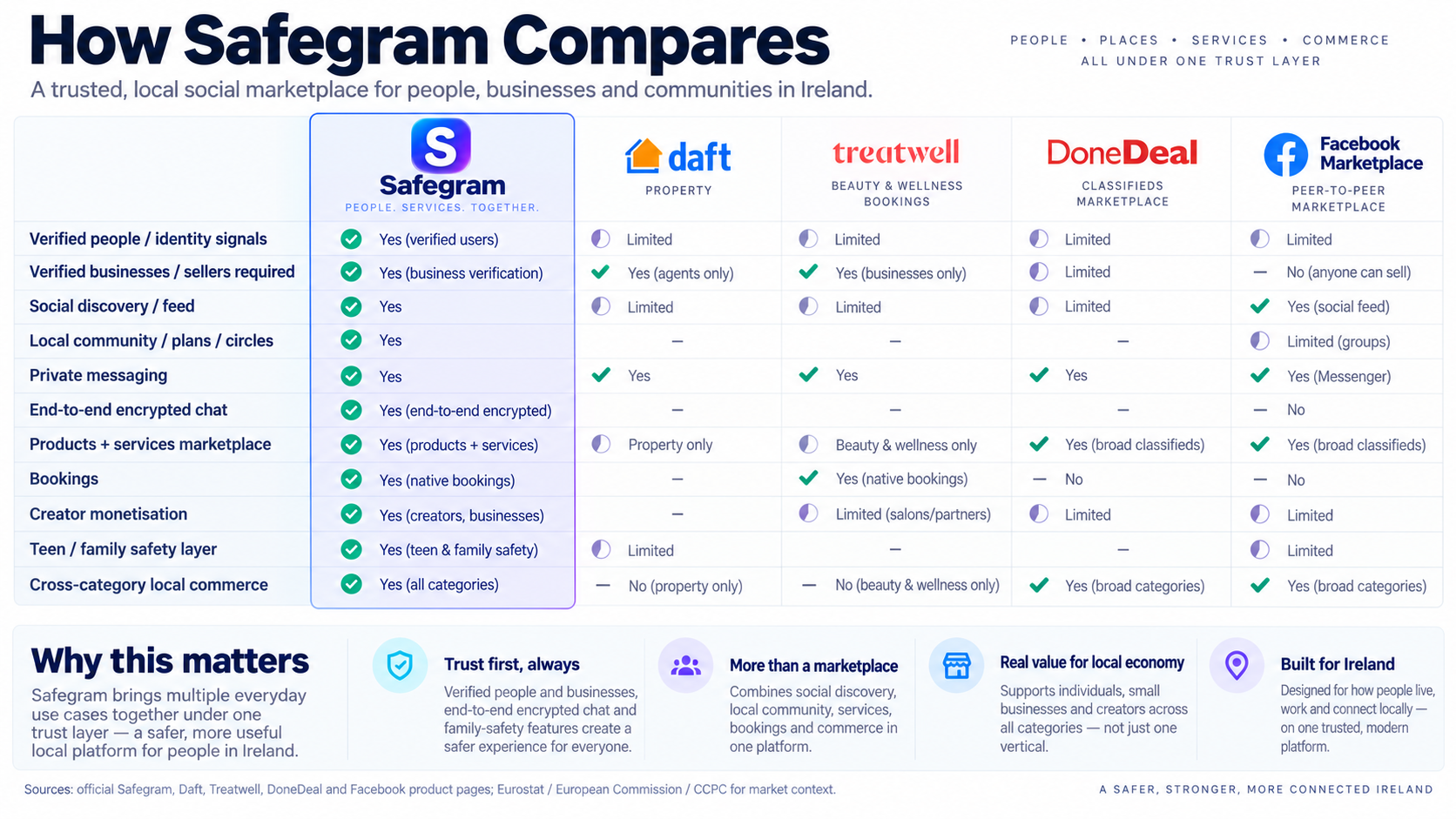
How safegram compares
Investor snapshot: Simplified product-positioning view based on public product pages as of 6 October 2026. It is not an exhaustive feature audit; competitor capabilities vary by market and can change.
Daft — the property specialist
Daft’s strength is depth.
It is purpose-built around property search, property listings, estate agents, landlords, new homes and related property tools. Its scale, inventory and consumer habit are major advantages.
Safegram should not pretend that a young cross-category platform is immediately stronger at property search.
The opportunity is adjacent: Safegram can allow verified property businesses, landlords, developers and related service providers to build a social presence, publish offers or listings, communicate with customers and participate in the same local ecosystem as trades, interiors, maintenance, legal, finance and other services.
For investors, that means Daft validates the value of vertical intent. Safegram’s bet is that there is also value in the relationship before and after the property search.
Treatwell — the booking specialist
Treatwell has built a focused European marketplace around hair, beauty and wellness, with appointment discovery and 24/7 booking at the centre of the experience.
That focus is a strength.
Safegram’s opportunity is breadth.
A beauty professional on Safegram can sit beside restaurants, trades, creators, property businesses, shops and professional services under the same verified commercial identity layer. The business can be discovered in social content and local feeds, not only when somebody opens a beauty-specific booking app.
Treatwell optimises a vertical booking journey.
Safegram is trying to connect discovery, identity, content, community and commerce across many everyday categories.
Donedeal — the classifieds powerhouse
DoneDeal has enormous strength in Irish classifieds, particularly cars and motors, while also supporting a wide range of other categories.
It proves something important: Irish people are comfortable buying, selling and researching high-value goods online.
Safegram’s differentiation is the relationship around the listing.
Safegram requires every business, creator and seller to complete verification before the first commercial listing goes live. Its wider product also includes social profiles, encrypted messaging, communities, Plans, services, offers and business discovery.
That creates a different intended experience: not only “find an item”, but “understand who is behind the account, follow them, interact with them and potentially transact with them again.”
Facebook marketplace and instagram — the attention giants
Meta has a structural advantage no startup can sensibly dismiss: audience.
Facebook Marketplace connects local buyers and sellers inside an enormous social network. Instagram gives creators and businesses discovery, content distribution, messaging and increasingly sophisticated business and AI tools.
Meta’s own 2026 reporting says there are more than one billion active threads with businesses across WhatsApp, Messenger and Instagram every day.
That demonstrates the scale of conversational commerce.
Safegram cannot compete with that reach today.
Its potential advantage is product philosophy.
Safegram’s commercial layer requires verified sellers. Its messaging is end-to-end encrypted. Its public positioning emphasises minimum data collection, user feed control, local discovery and a trust layer that applies across people, businesses, creators, Plans, Circles and Exchange.
The investor question is whether a smaller network built around those defaults can create higher-quality local interactions even without Meta-scale reach.
Bark and tradesmen.ie — the services and leads specialists
Bark connects customers with professionals across hundreds of service categories and charges professionals for leads they choose to contact.
Tradesmen.ie helps Irish customers obtain up to four quotes from rated tradespeople.
Both models solve an important problem: matching intent with available professionals.
Safegram’s proposed advantage is continuity.
A business does not need to exist only when a lead appears. It can maintain a verified profile, publish content, list services, create offers, receive enquiries, participate in local discovery and build an audience that can return.
That could matter particularly for service businesses where repeat work, referrals, reputation and community presence are valuable.
The competitive map, without the marketing spin
The most credible comparison is not a row of green ticks claiming that Safegram does everything and competitors do nothing.
That would be wrong.
Each established platform has a moat.
Daft has property liquidity and brand habit.
Treatwell has category expertise and booking density.
DoneDeal has inventory, traffic and marketplace familiarity.
Meta has distribution, social graphs, advertising infrastructure and business messaging at extraordinary scale.
Bark and Tradesmen.ie have service-intent funnels and professional matching.
Safegram’s proposed moat is different:
one verified commercial identity across multiple categories;
a social graph and local feed around that identity;
commercial listings and services through Exchange;
Offers and curated discovery through Safegram Select;
Plans and Circles that connect online communities to real-world activity;
end-to-end encrypted chat;
seller and business verification before commercial listing;
family-safety functionality;
and a business model that can combine subscriptions, commercial tools, bookings, transactions and promotion.
The opportunity only becomes defensible if those pieces reinforce one another.
A list of features is not a moat.
A network of trusted relationships, businesses, communities, repeat transactions and local reputation can become one.
Where safegram can be better
“Better” should be defined narrowly and measurably.
Safegram does not need to be better than Daft at showing every property listing in Ireland.
It needs to be better at helping a verified local property business participate in a wider trusted community.
It does not need to be better than Treatwell at every salon workflow.
It needs to be better at giving a beauty professional one identity that can combine content, reputation, offers, community, messages and commerce.
It does not need to beat DoneDeal on listing volume.
It needs to prove that compulsory commercial verification plus social context can create a higher-trust marketplace experience.
It does not need to out-distribute Instagram.
It needs to prove that a smaller feed with more user control and stronger identity signals can create commercially valuable engagement.
It does not need to replace Bark or Tradesmen.ie.
It needs to prove that professionals gain more long-term value from a persistent verified presence than from repeatedly buying or competing for individual leads.
That is a far more believable competitive thesis than claiming Safegram will simply replace the incumbents.
The irish market is attractive enough to test it
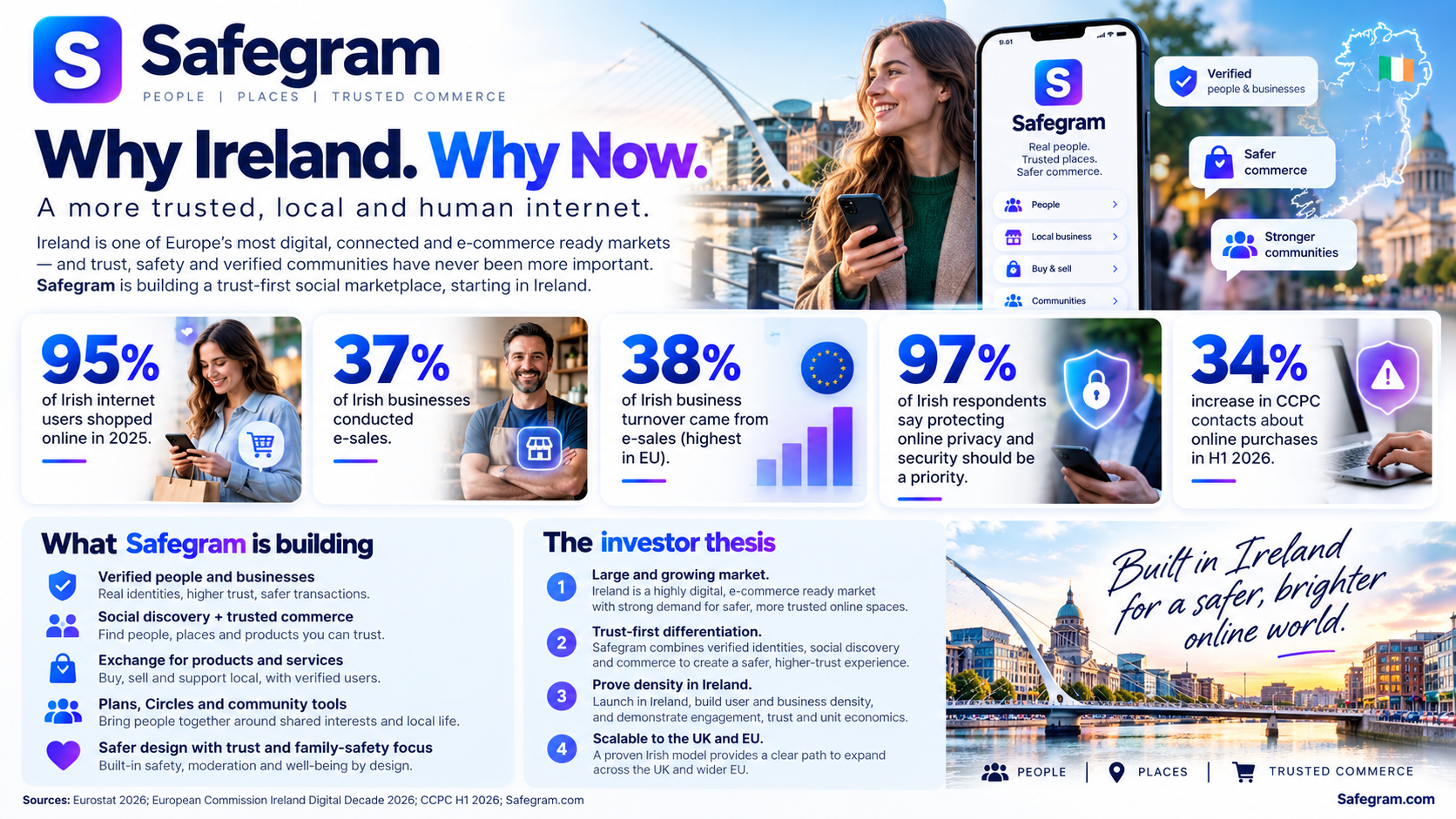
Investor snapshot: Why Ireland, why now — the thesis rests on existing digital-commerce behaviour plus unusually strong demand for privacy, safety and verified interaction.
The wider market environment supports the experiment.
Eurostat reports that 37% of Irish businesses conducted e-sales in 2025, compared with 24% across the EU.
Ireland also recorded the highest share of business turnover generated from e-sales in the European Union at 38%.
This is not a market that needs to be taught how to transact digitally.
It is a market where the next layer of competition can focus on quality, trust, discovery and efficiency.
At the same time, the Competition and Consumer Protection Commission reported that 22,724 consumers contacted its helpline in the first half of 2026 and that contacts related to online purchases rose 34%.
That does not mean digital commerce is failing.
It means digital commerce is economically important enough that trust, clarity and consumer protection matter more.
Irish public opinion points in the same direction.
The European Commission’s 2026 Digital Decade report found that 97% of Irish respondents see protecting online privacy and security as a priority for the next decade, while 97% support stronger online protection for children and young people.
Safegram is trying to build where those two curves meet:
more digital commerce;
more demand for trust.
What safegram has live today
According to Safegram’s current public product pages, the platform is live on iPhone and Android.
The current public product includes:
- social profiles and feeds;
- verified profiles and visible trust signals;
- end-to-end encrypted chat;
- Safegram Exchange;
- verified sellers, creators and businesses;
- products, services and offers;
- Safegram Select;
- Plans for real-world meetups;
- Circles for smaller communities;
- Family Safety Layer;
- reporting and safety tools;
- local and verified discovery;
- business discovery and AI-assisted business tools.
The commercial verification rule is particularly important.
Safegram states that every business, creator and seller must complete Didit-powered KYC or KYB checks before their first listing can go live. Ordinary members can browse and post without verification, while commercial sellers cannot list without it.
Verification is not a guarantee that somebody will behave honestly in the future.
It is an accountability signal.
That is the correct standard to communicate to investors and users.
What safegram still has to prove
The strongest incumbents have something Safegram does not yet have at comparable scale:
liquidity.
Daft has millions of monthly users and deep property inventory.
Treatwell has tens of thousands of partners.
DoneDeal has years of listings, traffic and marketplace behaviour.
Meta has billions of users across its ecosystem.
Safegram is early.
That is not a weakness to hide. It is the central risk the next funding round should address.
The €250,000 raise should be judged on whether it can prove:
1. local density
Can Safegram build enough verified businesses, creators and users in concentrated Irish areas that the product becomes useful without national scale?
2. activation
Do businesses move from sign-up to verification, listings, services, offers, enquiries and bookings?
3. retention
Do people return after the initial launch because the platform solves a repeated need?
4. paid conversion
Will businesses and creators pay for higher-value visibility, workflow, promotion and AI-assisted tools?
5. transaction quality
Do verified commercial relationships produce measurable bookings, leads or transactions?
6. customer acquisition efficiency
Can Safegram acquire both supply and demand at a cost that can support a scalable marketplace?
7. category expansion
Can density built in one or two local categories make adjacent categories easier to activate?
8. geographic repeatability
Can the Irish playbook move from initial Dublin areas into other Irish markets and then into the UK and EU?
Those are the metrics that turn an ambitious platform idea into an investable company.
Why cross-category can matter
Vertical marketplaces are powerful because they compress one customer problem.
Cross-category platforms become powerful when one identity can solve multiple problems.
That is harder.
It can also create deeper network effects.
A restaurant owner is also a property renter, a parent, a customer of tradespeople and potentially a creator.
A tradesperson may use Safegram to find work, discover suppliers, join a local business Circle and organise a football Plan.
A beauty professional may publish content, sell products, take bookings and discover a local photographer for a campaign.
A creator may sell services to businesses, attend networking Plans and recommend verified local venues.
The same person can move between consumer, creator and business roles.
A trust layer becomes more valuable when identity and reputation travel with that person across those contexts.
That is the larger Safegram thesis.
Why the model could scale beyond ireland
Ireland is a strong proving ground because it is digitally mature, geographically compact and commercially connected to the UK, Europe and the United States.
But international expansion should be earned.
The first job is to prove the marketplace in concentrated Irish communities.
If Safegram can demonstrate that verification improves conversion or transaction confidence, that local businesses will pay for distribution and tools, and that users engage across multiple categories, the model becomes more portable.
The UK is a natural next test because many of the same marketplace categories exist at larger scale.
European expansion then benefits from a product already designed around European privacy, safety and platform-regulation expectations.
The strategic sequence is therefore:
Ireland for density and proof.
UK for scale.
EU for replication.
Not the reverse.
The investor case in one paragraph
Daft, Treatwell, DoneDeal, Meta, Bark and Tradesmen.ie already prove that consumers want digital discovery, marketplaces, bookings, messaging and service matching.
Safegram is not investing against that evidence.
It is investing on top of it.
The thesis is that the next layer of value comes from connecting those behaviours around one verified identity, one local social graph and one commercial relationship.
If Safegram can prove that this creates higher trust, better repeat engagement and monetisable business outcomes in Ireland, it has a credible route from a local launch into a wider European social-commerce category.
The most important difference
The defining Safegram question is not:
“Does it have more features than Daft or Treatwell?”
It is:
“Does combining verified identity, community and commerce change user behaviour enough to create a new category?”
If the answer becomes yes, Safegram is not merely another marketplace.
It becomes infrastructure for trusted local digital relationships.
That is the opportunity investors should evaluate.
Frequently asked questions
Is Safegram trying to replace Daft?
No. Daft is a deeply established property marketplace. Safegram’s opportunity is cross-category verified social commerce, including property-related businesses and services, rather than attempting to reproduce Daft’s entire specialist property product on day one.
How is Safegram different from Treatwell?
Treatwell is focused on beauty and wellness discovery and bookings. Safegram is designed to work across many local categories while combining social profiles, verification, communities, services, offers, messaging and commerce.
How is Safegram different from DoneDeal?
DoneDeal is a major Irish classifieds marketplace with particular strength in motors. Safegram’s commercial model requires seller verification before listing and combines marketplace activity with social discovery, services, communities, Plans and encrypted chat.
Why not just use Facebook Marketplace or Instagram?
Meta offers enormous reach, discovery and messaging. Safegram’s differentiation is a smaller trust-first architecture where commercial sellers must verify, private chat is end-to-end encrypted, local/community tools sit beside commerce and users have more explicit feed and visibility controls.
How is Safegram different from Bark or Tradesmen.ie?
Bark and Tradesmen.ie are focused on matching customers with professionals or quotes. Safegram aims to give businesses a persistent verified presence combining content, local discovery, services, offers, communication, bookings and community relationships.
Does Safegram claim to be better than all of these platforms?
No. Each incumbent has significant strengths and scale. Safegram’s claim is narrower: it is attempting to combine verified identity, social discovery, local community and commerce in one platform rather than optimise only one vertical.
Is Safegram live?
Yes. Safegram’s current public website states that the platform is live on iPhone and Android.
Are all commercial sellers verified?
Safegram’s published policy states that every business, creator and seller must complete verification before the first commercial listing can go live.
How much is Safegram raising?
Safegram is preparing a €250,000 early-stage investment round focused on proving the Irish commercial model, marketplace density, retention, paid conversion and readiness for wider UK and EU expansion.
What is the biggest investment risk?
Marketplace liquidity. Safegram needs enough useful supply and enough active users in concentrated locations to create repeat behaviour. That is why an Ireland-first density strategy matters.
Investor CTA
The opportunity is not to rebuild six established platforms inside one app.
It is to build the layer those platforms prove people already need:
discovery;
identity;
community;
communication;
and commerce.
Safegram is starting in Ireland with a €250,000 raise designed to prove whether that integrated trust layer can become a repeatable business.
Investors, strategic partners and ecosystem organisations interested in Safegram’s current funding round can contact:
Silvestru Macoveiciuc
Founder & CEO, Safegram
silvestru@safegram.com
safegram.com
Safegram — Real People. Real Businesses. Safer Communities.
Investor disclosure
This is company-produced editorial material describing Safegram’s strategy, competitive positioning and planned funding round. It is not an offer of securities, investment advice or a substitute for formal investment documentation and due diligence. Competitor descriptions are based on publicly available product information and are intended to explain positioning, not to imply that one service is universally superior to another.
Source references
- Safegram — official product overview.

https://safegram.com/
- Safegram — Privacy & Security / verified seller policy.
https://safegram.com/security
- Safegram — Verification partner and commercial verification policy.
https://safegram.com/verification-partner
- Safegram — Plans.
https://safegram.com/plans
- Daft — About.
https://support.daft.ie/hc/en-ie/articles/360007696318-About
- Daft — Site Map / property focus.
https://support.daft.ie/hc/en-ie/articles/360003965418-Daft-Site-Map
- Treatwell Ireland — About Us.
https://www.treatwell.ie/info/about-us/
- Treatwell Ireland — consumer booking platform.
https://www.treatwell.ie/
- DoneDeal — marketplace and product pages.
https://www.donedeal.ie/
- Facebook — Marketplace product overview.
https://about.fb.com/news/2016/10/introducing-marketplace-buy-and-sell-with-your-local-community/
- Meta — Business Agent and business messaging, June 2026.
https://about.fb.com/news/2026/06/meta-business-agent/
- Bark Ireland — How it works for customers and professionals.
https://www.bark.com/en/ie/how-it-works/customers/
https://www.bark.com/en/ie/how-it-works/sellers/
- Tradesmen.ie — About / How it works.
https://www.tradesmen.ie/about-us
- Eurostat — Digitalisation in Europe, 2026 edition.
https://ec.europa.eu/eurostat/en/web/interactive-publications/digitalisation-2026
- European Commission — Ireland’s 2026 Digital Decade Country Report.
https://digital-strategy.ec.europa.eu/en/factpages/irelands-2026-digital-decade-country-report
- Competition and Consumer Protection Commission — Consumer Helpline Report H1 2026.
https://www.ccpc.ie/about-us/advocacy-and-research/research/publication-details/consumer-helpline-report-h1-2026
More from Safegram
Try Safegram
Privacy-first social and a verified marketplace, built in Dublin.