
Ireland’s Children Are Still Seeing Harmful Content Online. Safer Social Media Has to Be Designed Differently
New evidence from CyberSafeKids shows harmful content and unwanted contact remain common for Irish children online, highlighting the need for safety-by-design in social media.
Standfirst
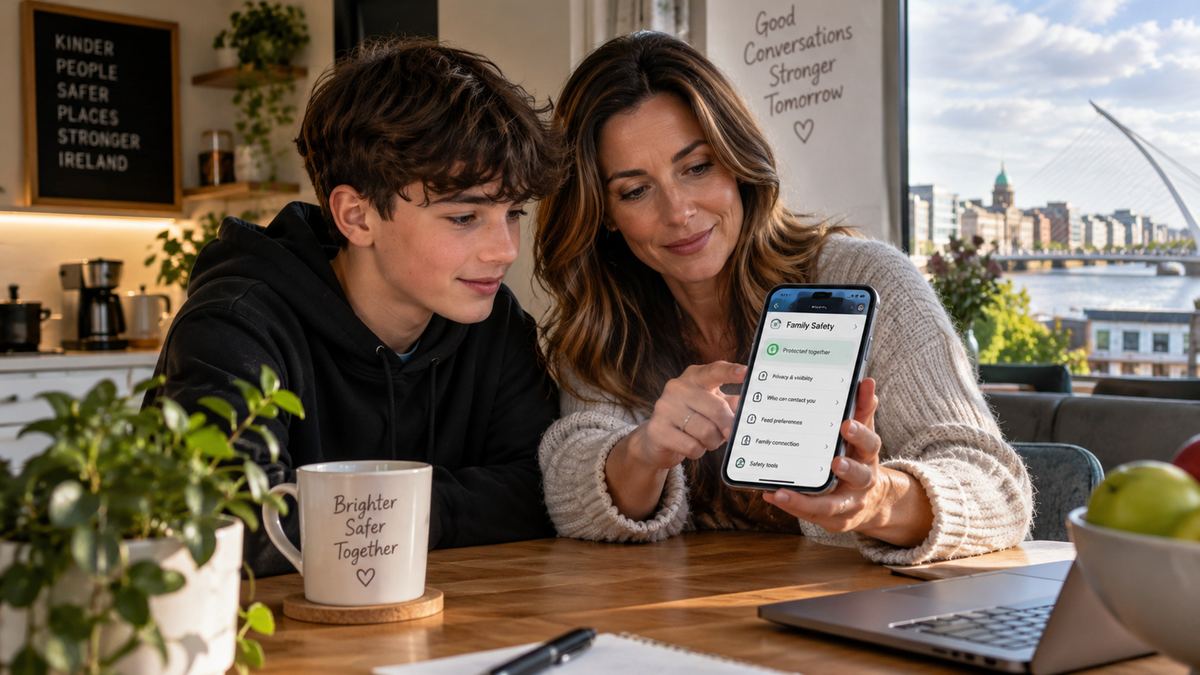
Children in Ireland are growing up inside digital environments that were largely designed for adults. New 2026 evidence from CyberSafeKids shows that harmful content, unwanted contact and under-age access to 13+ platforms remain common. The lesson is increasingly clear: safer social media cannot rely only on parents, reporting buttons or screen-time limits. Safety has to be built into the product itself.
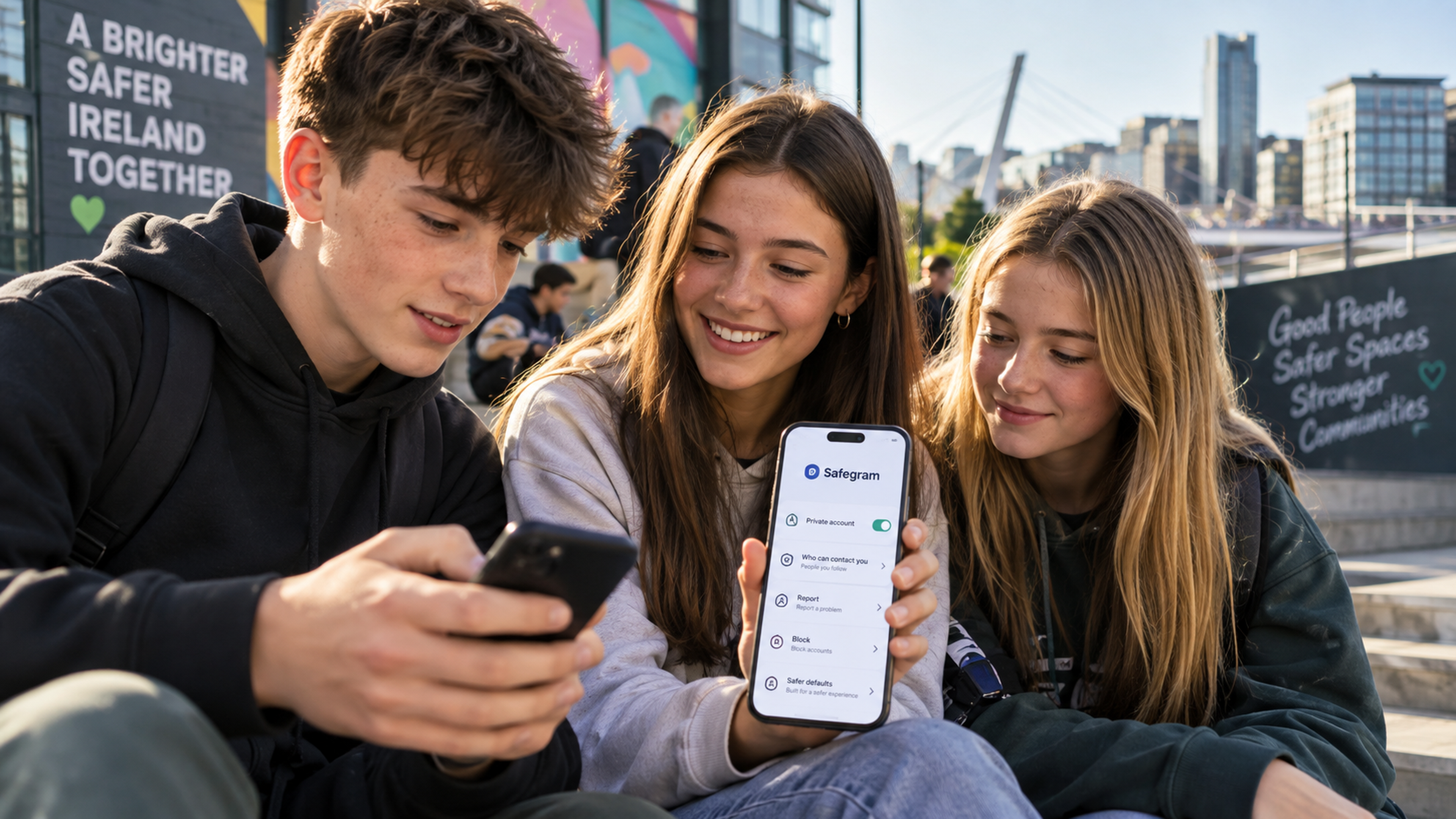
Stronger defaults and understandable controls can reduce avoidable risks for younger users. Illustrative Safegram editorial visual.
Key takeaways
- CyberSafeKids surveyed more than 7,000 children aged 8–15 in Ireland during the 2025–26 academic year.
- 26% of 8–12-year-olds and 25% of 12–15-year-olds said they experienced content or unsolicited contact that bothered them.
- 70% of 8–12-year-olds still reported having accounts on social media apps whose stated minimum age is 13+.
- EU and Irish online-safety frameworks increasingly emphasise safer defaults, age assurance, parental controls, transparent recommender systems and protections from targeted advertising.
- Safegram’s current public product information says its Family Safety Layer is live, alongside end-to-end encrypted chat, feed controls and no targeted advertising to minors.
The latest CyberSafeKids report is titled The Year Little Changed. The name is significant. It suggests that despite years of debate, new laws and growing public awareness, many of the risks children experience online remain stubbornly familiar.
The report draws on responses from more than 7,000 children aged 8–15 across Ireland during the 2025–26 academic year. It found that 26% of children aged 8–12 and 25% of those aged 12–15 had experienced content or unsolicited contact that bothered them. The examples covered misinformation, threats, violence, sexual material and dangerous ideas.
The same report found that 70% of 8–12-year-olds still had accounts on social media services with a stated minimum age of 13. It also found that generative AI use has become mainstream among young people: 55% of primary-age respondents and 76% of secondary-age respondents had used chatbots for homework, friendship or information.
Those figures point to a wider problem. Young people are not entering one simple digital space. They are moving between messaging apps, games, social feeds, creator platforms and AI tools — often before adults fully understand how those systems interact.
The problem is not only ‘screen time’
Screen-time limits can be useful. Parents should still set boundaries, talk openly with children and understand the platforms they use. But time limits do not answer some of the most important safety questions.
Who can contact a young person? What does the feed recommend next? Can strangers discover the account? Are sensitive settings private by default? Does the platform know enough about age to apply appropriate protections? Can a child report a problem easily? Does advertising rely on profiling a minor?
A teenager can spend less time online and still encounter an unsafe interaction in seconds. That is why the policy conversation in Europe has moved toward safety by design rather than simply telling families to manage the consequences.
Europe is increasingly asking platforms to design differently
The European Commission’s guidelines on the protection of minors under the Digital Services Act, published in July 2025, set out measures intended to help platforms provide a high level of privacy, safety and security for children. The areas they address include unwanted contact, addictive design, cyberbullying, harmful content and harmful commercial practices.
In Ireland, Coimisiún na Meán’s Online Safety Framework also points to measures such as age assurance, parental controls, easy reporting, transparency around recommender systems and no targeted advertising to children where the relevant legal conditions apply.
The Irish regulator also highlights the risk of online ‘rabbit holes’. Under the Digital Services Act, platforms using recommender systems must explain in plain language how those systems work and what choices users have to influence them. For very large platforms, recommender-system risks must also be assessed and mitigated.
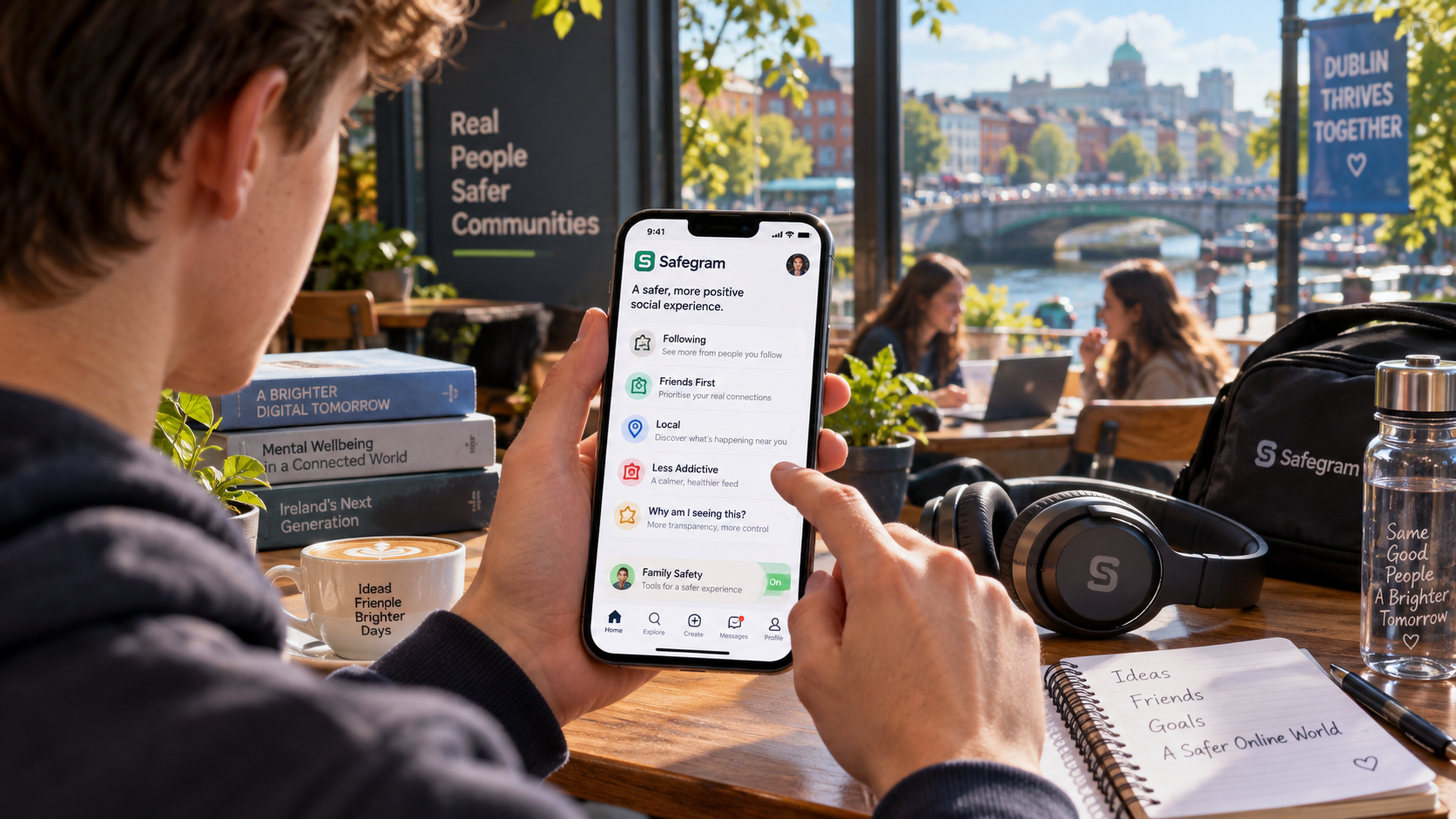
Feed transparency and user choice are increasingly important parts of online safety. Illustrative Safegram editorial visual.
What safer social media should look like in practice
The strongest safety model is layered. No single feature solves everything. A safer platform combines defaults, identity and age controls, messaging restrictions, feed design, reporting, privacy and family tools so that one failure does not leave a young person completely exposed.
- Safer defaults from the first login. Young accounts should begin with stronger privacy and contact restrictions rather than requiring a child to find the right settings later.
- Age assurance that is proportionate and privacy-conscious. Platforms need a credible way to apply age-appropriate protections without collecting more personal data than necessary.
- Stronger controls over unwanted contact. The ability for unknown adults to find, follow or message younger users should be constrained according to age and risk.
- Transparent feeds. Young people should have understandable choices over how content is recommended and alternatives that do not depend entirely on behavioural profiling.
- Fast reporting and escalation. Reporting needs to be easy to find, easy to understand and capable of prioritising serious child-safety concerns.
- No behavioural advertising to minors. Children should not have to trade detailed profiling for access to a social environment.
Safegram’s approach: family safety built into the product
Safegram is a Dublin-built privacy-first social marketplace. According to Safegram’s current public product pages, its Family Safety Layer is live in the iPhone and Android apps rather than being a future roadmap item.
Safegram’s public material describes age-appropriate defaults, stronger privacy for younger accounts, restricted messaging for young users, priority handling of reports involving minors and no targeted advertising to minors. Safegram also says age-sensitive flows use Didit’s age-estimation technology to help gate teen and family-safety features.
That does not mean Safegram — or any platform — can promise a risk-free environment. Age estimation can be imperfect. Harmful behaviour can still occur. Parents, schools, platforms, regulators and young people themselves all remain part of the safety picture.
The more important principle is that families should not have to discover every safety setting after something goes wrong.

Healthy social technology can support real-world activity instead of optimising only for more screen time. Illustrative Safegram editorial visual.
The feed deserves as much attention as the messaging system
A large part of online risk is not delivered by a stranger in a direct message. It can also come from what the recommendation system repeatedly places in front of a user.
That matters because recommendation systems shape what feels normal, what becomes visible and what a young person sees next. Transparency and user choice are therefore becoming core safety features, not simply user-experience preferences.
Safegram’s current public product information lists multiple feed modes, including Following, Friends First, Local and Less Addictive, together with a ‘Why am I seeing this?’ explanation layer. The goal is to give users more direct influence over how content reaches them.
For young users in particular, that direction matters. A safer feed should not be judged only by whether one harmful post is removed after it is reported. It should also be judged by whether the system keeps pushing users toward increasingly extreme, addictive or inappropriate material in the first place.
Safer social media should also help people leave the feed
There is another design choice worth discussing: whether the platform wants every spare minute of a person’s attention.
Safegram’s broader product includes Plans and Circles, designed to help people move from online discovery into smaller communities and real-world activities such as coffee, sport, walks, study or local events. Visibility and trust controls can be applied around those interactions.
That does not make offline activity a child-safety mechanism by itself. But it reflects an important philosophy: the healthiest possible social product may be one that does not measure success only by how long it can keep someone scrolling.
Parents still matter — but they should not carry the whole burden
No technology can replace a parent, guardian, teacher or trusted adult. Conversations about uncomfortable messages, pressure, sexual content, misinformation, AI-generated material and online relationships remain essential.
But placing the entire responsibility on families ignores the power imbalance between a child and a global platform. Parents do not design the recommendation system. They do not choose the default privacy settings. They do not decide who can contact a young user or how quickly a safety report is handled.
Platforms make those choices.
That is why regulation, product architecture and parental involvement need to work together.
The opportunity for Ireland
Ireland sits at an important point in the global online-safety debate. It is home to European operations for many major technology companies, it now has an increasingly developed online-safety regulatory framework, and organisations such as CyberSafeKids continue to produce detailed evidence about what Irish children are actually experiencing.
The next step should not be another cycle of outrage followed by minor settings changes. It should be a competition to build better digital environments.
For Safegram, that means being judged against a demanding standard: safer defaults, credible age assurance, privacy, transparent feed controls, stronger restrictions on unwanted contact, rapid reporting and a business model that does not depend on profiling minors.
If the industry can make those ideas normal rather than exceptional, the phrase ‘safer social media’ may finally describe the architecture of the product — not just the promises on its safety page.
Conclusion
The 2026 CyberSafeKids findings show why this debate is urgent. A quarter of surveyed children in both age groups reported content or unsolicited contact that bothered them, and under-age access to 13+ services remains widespread.
The response cannot be one button, one law or one parental rule. Safer social media requires layers of protection that work before, during and after a risky interaction.
For the next generation of social platforms, safety should not be an extra feature. It should be part of the product definition.
Frequently asked questions
What does ‘safer social media for teens’ mean?
It means designing social platforms with stronger privacy defaults, age-appropriate contact controls, transparent recommendation systems, easy reporting, protection from targeted advertising and other measures that reduce predictable risks for young users.
Does age verification solve online child safety?
No. Age assurance can help a platform apply the right protections, but it must be combined with privacy, moderation, messaging controls, feed design, reporting and family involvement.
What did CyberSafeKids find in 2026?
Its 2026 report, based on more than 7,000 Irish children aged 8–15, found that 26% of 8–12-year-olds and 25% of 12–15-year-olds experienced content or unsolicited contact that bothered them. It also found that 70% of 8–12-year-olds had accounts on 13+ social media apps.
Is Safegram’s Family Safety Layer live?
Safegram’s current public product information says yes. It is listed as live in the iPhone and Android apps, alongside age-appropriate defaults, messaging restrictions for younger accounts, priority child-safety reporting and no targeted advertising to minors.
Does Safegram promise that children will never encounter harm?
No. No credible social platform can guarantee zero harm. The objective is to reduce predictable risks through product design, privacy, age-aware controls, reporting and accountability.
Sources
- https://www.cybersafekids.ie/report2026/
- https://digital-strategy.ec.europa.eu/en/library/commission-publishes-guidelines-protection-minors
- https://www.cnam.ie/general-public/online-safety/online-safety-framework/
- https://www.cnam.ie/industry-and-professionals/online-safety-framework/online-safety-code/
- https://www.dataprotection.ie/en/dpc-guidance/blogs/the-children-fundamentals
- https://safegram.com/
- https://safegram.com/verification-partner
More from Safegram
Try Safegram
Privacy-first social and a verified marketplace, built in Dublin.