
The €2 Parcel Fee Is Coming. Irish Shoppers Need to Know Where Orders Come From
Learn what the €2 EU handling fee means for Irish shoppers, why shipping origin matters and how to check the full cost before buying.

Independent Irish retail and clear seller information are increasingly important in online commerce.
THE ESSENTIALS
From 1 November 2026, the EU’s Union Handling Fee is €2 per distinct item in an e-commerce package arriving from outside the EU. It is separate from the €3 customs duty per distinct item that has applied since 1 July to packages worth €150 or less. Sellers or delivery businesses pay the new handling fee, but may pass the cost on to consumers. Goods already based in Ireland, Northern Ireland or another EU member state when ordered are not subject to these charges.
A new charge can sound like a small administrative change. In a country where 85% of internet users bought goods or services online in 2025, according to the Central Statistics Office, it raises a more immediate question: how can a buyer tell the true cost of an online order before pressing Pay?
WHAT EXACTLY CHANGES ON 1 NOVEMBER?
Revenue’s guidance is specific. The €2 Union Handling Fee applies per distinct item to business-to-consumer goods dispatched from outside the EU, regardless of order value. For consignments valued at €150 or less, it sits alongside the €3 customs duty per distinct item introduced on 1 July 2026. For packages above €150, normal product-specific customs duties apply instead of that flat €3 duty, while the €2 handling fee still applies.
The important words are “distinct item”, not simply “parcel”. Revenue’s examples show why. A €10 package containing a pen, notebook and key ring contains three different items: €9 in customs duty plus €6 in handling fees, or €15 before any applicable VAT. Two identical pens count as one distinct item type in Revenue’s example, producing €3 duty plus €2 handling fee, or €5 before any applicable VAT.
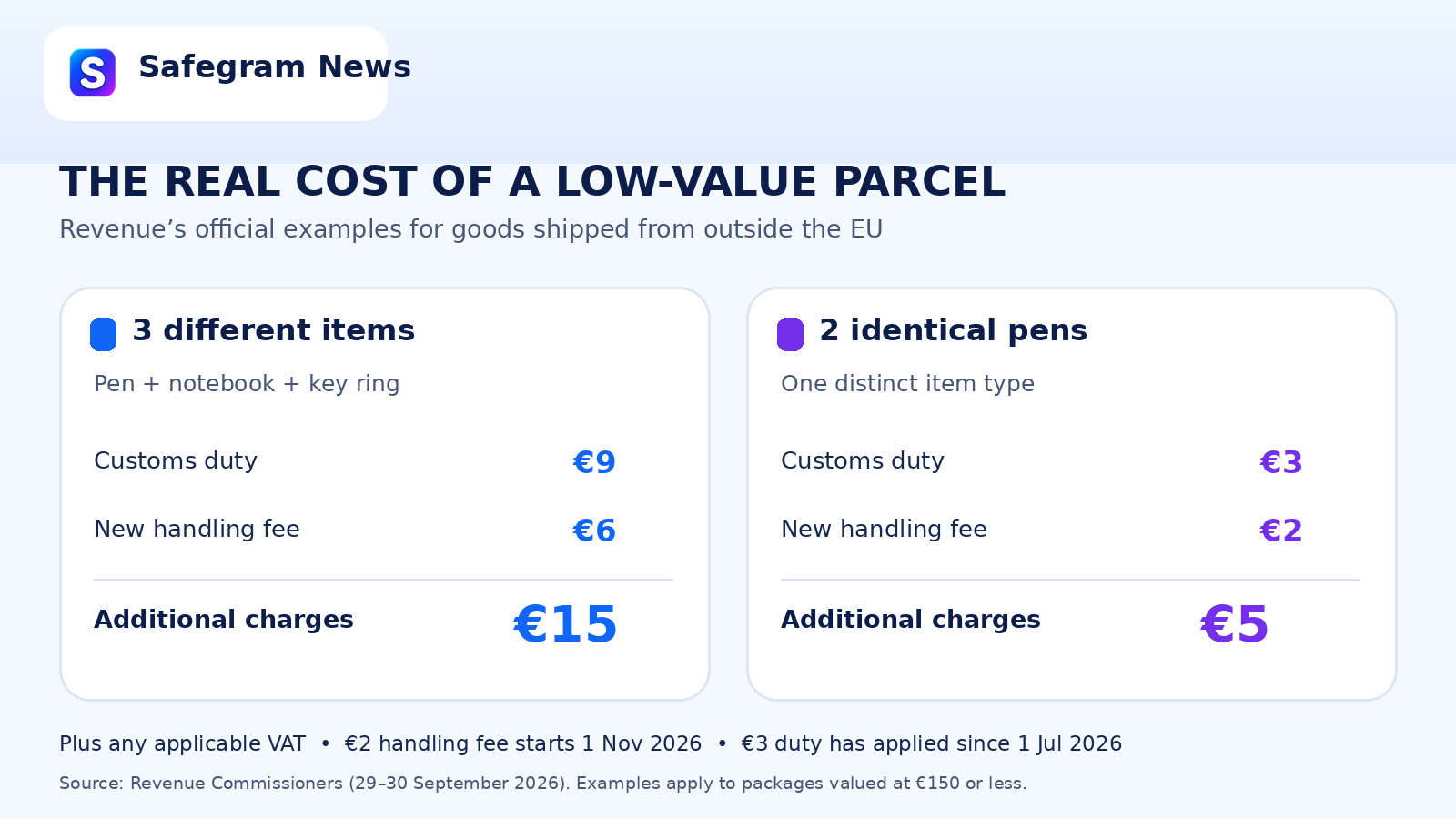
Revenue’s official worked examples: three distinct items versus two identical pens, before any applicable VAT.
WHO PAYS — THE SHOP, THE PLATFORM OR THE CUSTOMER?
The fee is aimed at e-commerce businesses and delivery operators bringing parcels into the EU, not designed as a direct charge automatically imposed on every shopper. But businesses may pass it on. Where a seller collects the applicable charges at checkout, the customer should see them before payment. Where it does not, a courier or postal operator may require payment before delivery; VAT can also be due if it was not collected earlier.
That difference matters. A low sticker price is not necessarily a low delivered price. Shoppers should compare the full landed cost — item price, delivery, applicable customs duty, handling fee and VAT — rather than comparing product prices alone.
A .IE ADDRESS IS NOT PROOF THE PARCEL IS COMING FROM IRELAND
Revenue explicitly warns that a website can look Irish or European, use a .ie domain and display euro prices while shipping goods from outside the EU. A seller’s registered address, its warehouse location and the country from which a particular order is dispatched are not always the same thing.
For a shopper, the practical questions are simple: Where is the business based? Where are these goods physically located before the order? Where will they be dispatched from? Are customs and handling costs included in the checkout total? And what happens to those charges if the product is returned?
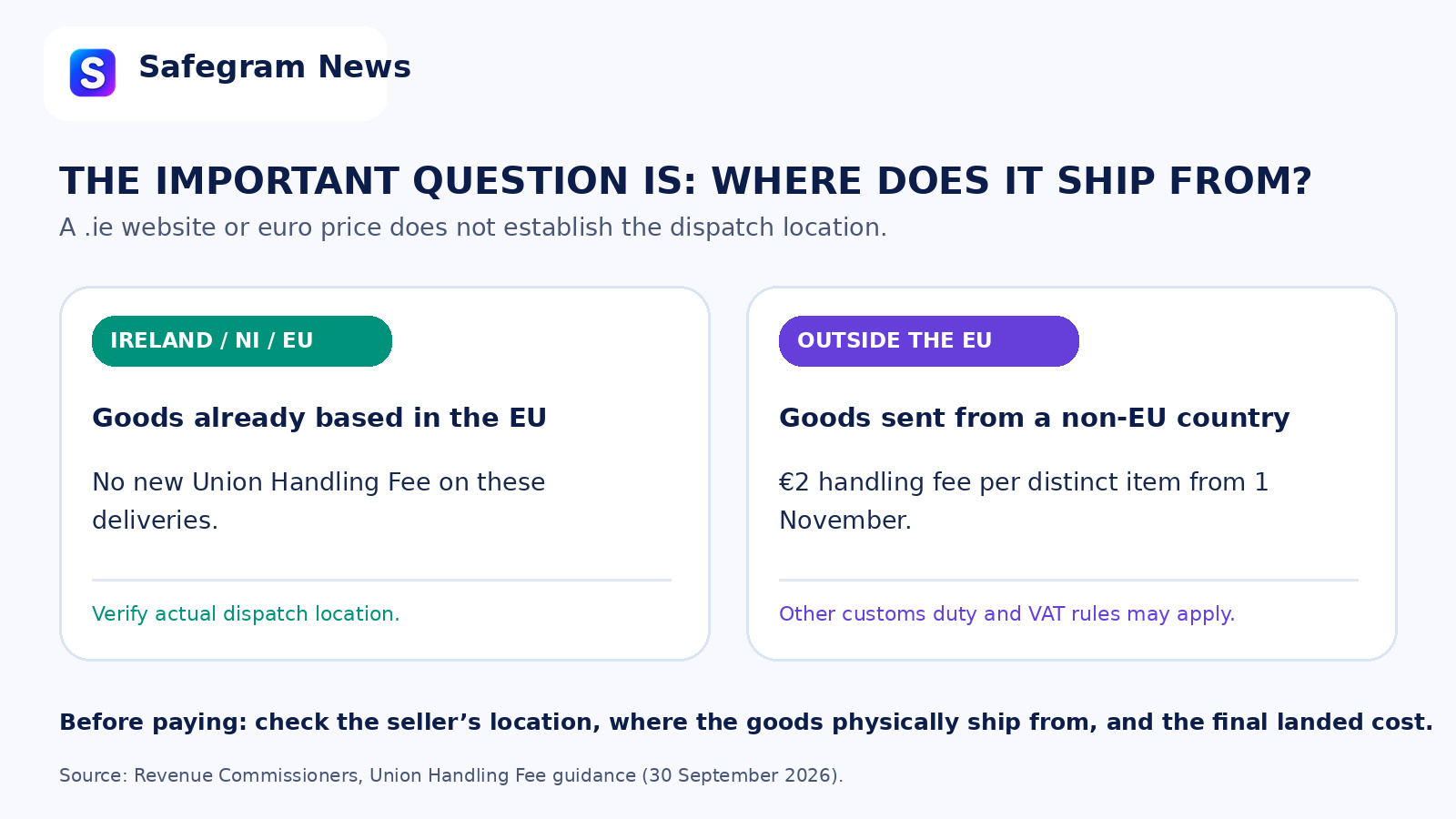
The dispatch location, not the website’s branding alone, determines whether the new handling fee applies.
LOCAL COMMERCE GAINS A CLEARER ARGUMENT — BUT MUST STILL EARN TRUST
The changes create an opportunity for Irish and EU-based retailers to make the value of local stock more visible: clearer delivery expectations, easier conversations with the seller, transparent returns and, where goods are already based within the EU, no new Union Handling Fee. That is a commercial advantage only when it is genuine and clearly explained; a local-looking storefront that fulfils orders from overseas should not imply otherwise.
This is also where social discovery and commerce overlap. People often encounter a product through a creator, local recommendation, business post or community conversation before they ever reach a checkout. They need to understand the seller behind the listing, not just the image in the feed. Safegram Exchange is built around verified business and creator accounts and the discovery of products and services within a social platform. That gives people a starting point for identifying who is offering something — but identity verification does not by itself establish shipping origin, eliminate customs charges or guarantee a transaction. Clear fulfilment information and accurate pricing still matter.
For small businesses, the lesson is practical. State where goods ship from, show what the buyer will pay, explain delivery times and make returns terms easy to find. A verified identity and an honest listing should reinforce one another. Neither substitutes for the other.
RETURNS, NORTHERN IRELAND AND THE SMALL PRINT
Revenue says the €2 Union Handling Fee is non-refundable, including when goods are faulty or returned. The separate €3 customs duty has different refund rules, and VAT refunds depend on the circumstances and seller’s accounting. Consumers should read the returns policy before ordering rather than assume every import-related cost will be reimbursed.
There is also an important distinction between Great Britain and Northern Ireland. Under the relevant EU–UK arrangements, goods moving between Northern Ireland and Ireland do not attract these customs charges. Goods shipped from Great Britain to Ireland may attract customs duty, VAT and the new handling fee. The fee does not apply to genuine private-person gifts sent from outside the EU to another private person in Ireland, according to Revenue’s guidance.
WATCH FOR PAYMENT SCAMS DISGUISED AS CUSTOMS NOTICES
A new fee creates a new phrase for criminals to misuse. Revenue says it will never send an email or text message requiring someone to click a link to pay customs duty or the Union Handling Fee. If a message claims a parcel is held until a charge is paid, do not use its link. Verify the delivery through the retailer or carrier’s official channel instead.
The wider trust problem is not solved by adding another badge to a product listing. Buyers need a chain of reliable information: a real seller, a truthful description, a clear dispatch origin, understandable total charges, secure communication and a credible route to resolve a problem. Platforms that make those details easy to verify can be more useful than those optimised only for the fastest click.
WHAT IRISH SHOPPERS SHOULD DO BEFORE NOVEMBER
For any order that might ship from outside the EU, check the dispatch country, calculate the total delivered price, confirm whether import charges are collected at checkout or on delivery, and read the returns policy. If the seller’s location or fees are unclear, ask before paying. The safest bargain is the one whose real price and seller you understand.
FREQUENTLY ASKED QUESTIONS
Does the €2 handling fee apply to every online purchase in Ireland?
No. It applies to qualifying business-to-consumer goods shipped from outside the EU from 1 November 2026. Goods already based in Ireland, Northern Ireland or another EU member state when ordered do not attract it.
Is the new charge €2 per parcel or per item?
It is €2 per distinct item in the package, according to Revenue. Multiple identical items may count as one distinct item type under the examples in its guidance.
Do I also pay the €3 customs duty?
For packages valued at €150 or less arriving from outside the EU, the €3 customs duty per distinct item has applied since 1 July 2026 and is separate from the €2 fee. Higher-value packages follow the relevant product-specific customs-duty rules.
Can a shop pass the new fee on to customers?
Yes. Revenue says the fee is paid by the e-commerce seller or delivery business, but the cost may be passed to the shopper at checkout or collected by a carrier before delivery.
What if the website ends in .ie or charges in euros?
Neither proves the parcel will ship from within the EU. Check the seller’s physical details and, more importantly, the location from which the particular goods will be dispatched.
Can I get the €2 fee refunded if I return an item?
No. Revenue states that the Union Handling Fee is non-refundable even if the item is returned or faulty. Other duties and VAT may have different refund rules.
A BETTER WAY TO DISCOVER AND BUY LOCALLY
If you want to discover real businesses, explore verified business profiles, products and services through Safegram Exchange. Wherever you shop, check the seller, shipping origin and full price before paying. Better online commerce starts with information people can trust.
SOURCES AND FURTHER READING
Revenue Commissioners — Union Handling Fee overview (30 September 2026):
https://www.revenue.ie/en/customs/individuals/union-handling-fee/index.aspx
Revenue Commissioners — Official announcement and worked examples (29 September 2026):
https://www.revenue.ie/en/corporate/press-office/press-releases/2026/pr-092926-handling-fee.aspx
Revenue Commissioners — How the fee applies:
https://www.revenue.ie/en/customs/individuals/union-handling-fee/how-the-fee-applies.aspx
Revenue Commissioners — Consumer guidance and scam warning:
https://www.revenue.ie/en/customs/individuals/union-handling-fee/what-does-this-mean.aspx
Central Statistics Office — Household Digital Consumer Behaviour 2025:
EDITORIAL PUBLISHING DATA — FOR CMS
SEO title: Ireland’s €2 EU Parcel Fee From November 2026: What Shoppers Need to Know
Meta description: From 1 November 2026, a €2 EU handling fee applies per distinct item shipped from outside the EU. Learn how it works, who pays and how to avoid surprises.
Suggested slug: ireland-eu-2-euro-parcel-handling-fee-november-2026
Primary intent: What is Ireland’s new €2 parcel handling fee, when does it start and who pays?
Secondary queries: EU handling fee Ireland 2026; €3 customs duty per item; shopping from UK to Ireland customs; shopping from China to Ireland fees; EU parcel fee returns; buying from Irish online shops.
Internal links: Safegram Exchange; verified businesses; local discovery; Safegram News on online-shopping scams. Link to existing live URLs only.
Suggested structured data: NewsArticle with publisher, author, datePublished, dateModified, image and source attribution; FAQPage only if the on-page FAQ meets current search-engine eligibility rules.
Image 1: safegram40_hero_irish_local_retail.jpg | Alt: Independent Irish retailer preparing an order while a customer checks her phone | Caption: The true cost of an online order depends on more than the listed price.
Image 2: safegram40_revenue_fee_examples.jpg | Alt: Revenue examples comparing €15 import charges for three distinct items with €5 for two identical pens, before VAT | Caption: Illustrative customs and handling-fee calculations based on Revenue guidance.
Image 3: safegram40_shipping_origin_guide.jpg | Alt: Comparison of goods shipped from within and outside the EU under November 2026 handling-fee rules | Caption: The dispatch location matters more than the domain name.
Editorial verification: Facts checked against Revenue guidance published 29–30 September 2026 and CSO 2025 household survey. Safegram product statements are descriptive, not claims of customs compliance or guaranteed fraud prevention.
More from Safegram
Try Safegram
Privacy-first social and a verified marketplace, built in Dublin.