
Why Your Feed Should Be Your Choice — and Why That Matters More Than Ever
Learn why user choice in social media feeds matters more than ever, especially with increasing regulatory scrutiny on addictive design and opaque recommender systems.
Standfirst
Social media feeds are no longer a neutral stream of updates. They shape attention, mood, behaviour and discovery. As regulators in Europe increase scrutiny of addictive design and opaque recommender systems, feed control is becoming one of the most important product questions in modern social media.
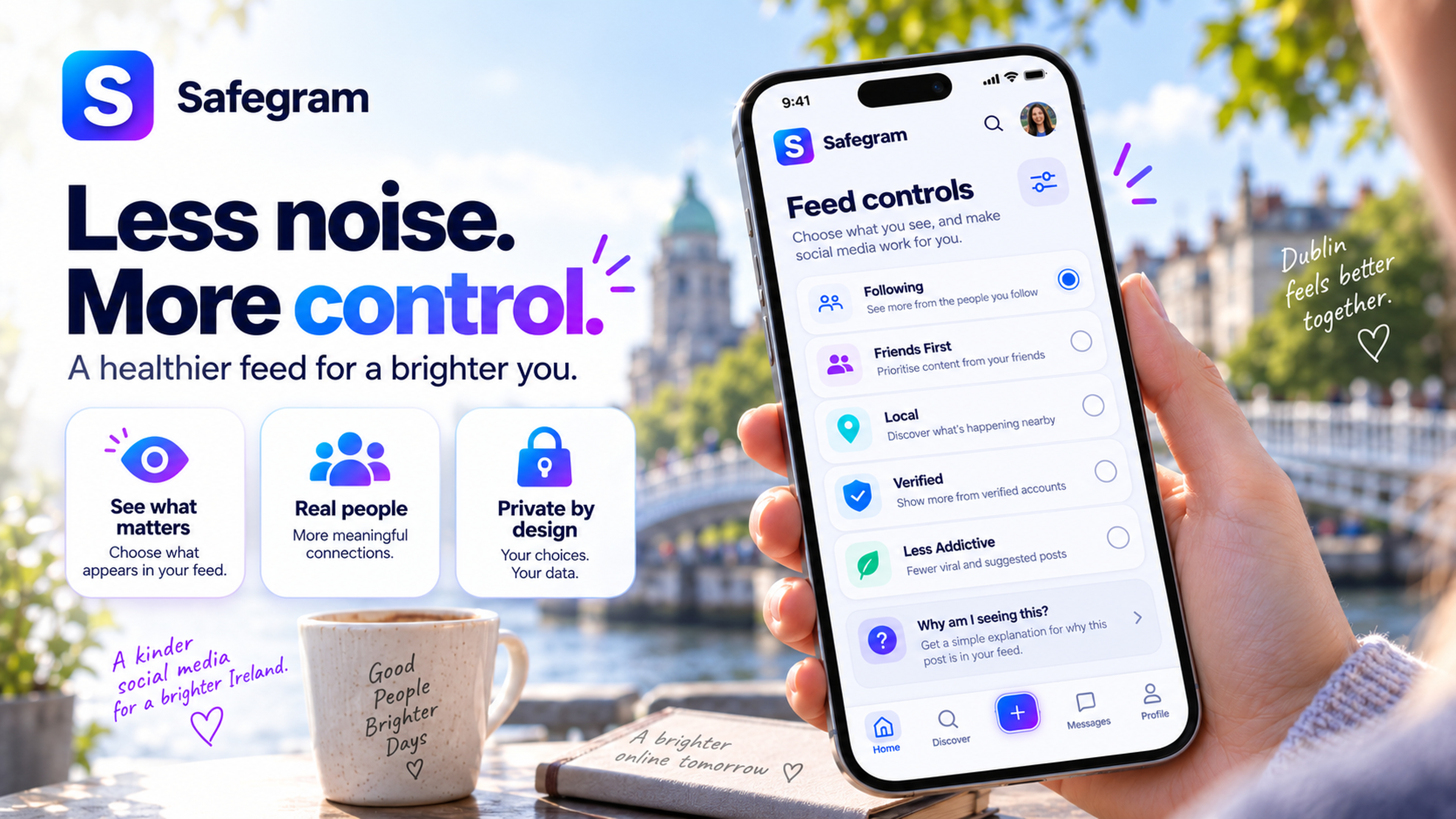
A better social experience starts with clear choices and understandable settings.
Key takeaways
- European regulators are paying closer attention to addictive design and how recommender systems influence what people see online.
- Under the Digital Services Act, platforms using recommender systems must explain key parameters in plain language, and very large platforms must provide at least one option not based on profiling.
- Coimisiún na Meán says young people have the right not to receive targeted ads and that platforms should take measures to reduce exposure to harmful content.
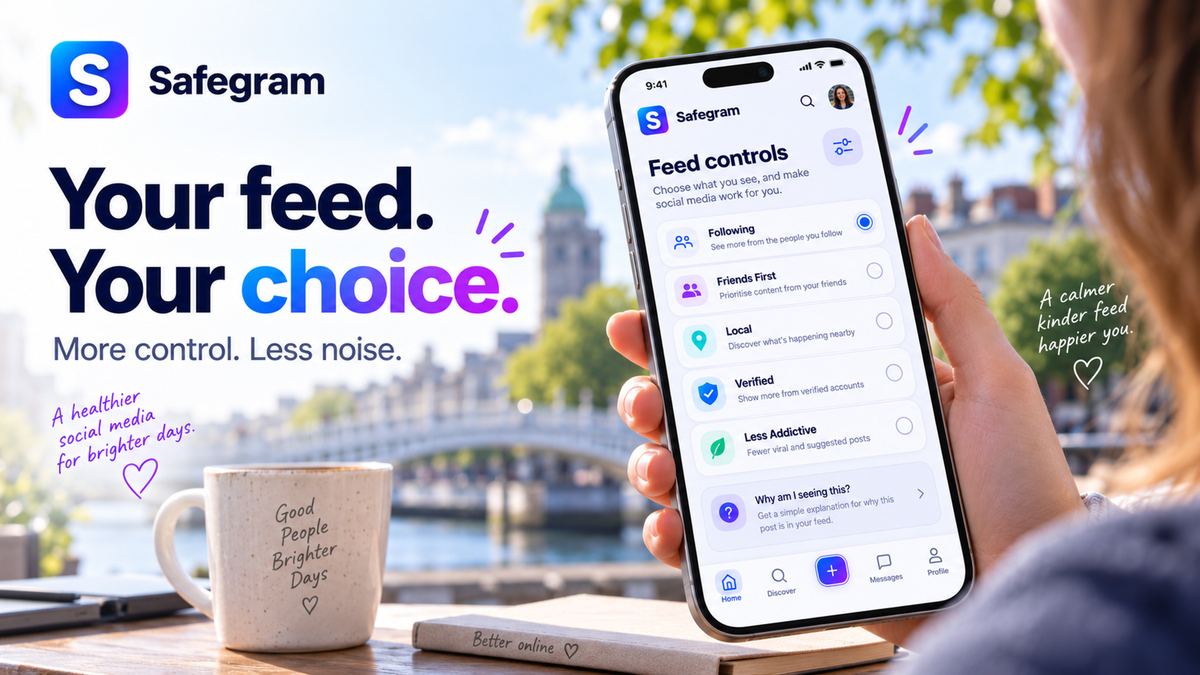
- Safegram publicly positions feed control as a core feature, with options such as For You, Following, Friends First, Local, Discover, Custom and Less Addictive, plus a “Why am I seeing this?” explanation.
- A healthier social product is not just about removing bad content. It is also about giving people more meaningful control over what enters their attention.
For years, social media products trained people to accept the feed they were given.
You open the app. The content rolls in. One video leads to another. A post you never asked for sits between updates from people you actually know. Something provocative gets boosted because it holds attention. Something local and genuinely useful gets buried because it is less optimised for reaction.
That model now faces more scrutiny than ever.
In 2026, the European Commission said it had preliminarily found Meta in breach of the Digital Services Act over the addictive design of Instagram and Facebook. The Commission pointed specifically to features such as infinite scroll, autoplay, push notifications and highly personalised recommender systems, and said the company had not adequately assessed the risks those systems posed to the wellbeing of users, including minors and vulnerable adults.
That matters because it confirms something many people already feel in everyday life:
The feed is not just a product feature — it is an influence system.
The feed is not neutral
A social feed decides what is easiest to notice.
That means it shapes:
- which voices feel close
- which topics dominate your attention
- whether the experience feels social or manipulative
- whether you leave the platform informed, inspired or drained
The problem is not that recommendation is always bad. Good recommendation can help people discover local events, useful communities, relevant creators and content they genuinely value.
The problem begins when recommendation becomes too opaque, too optimised for attention, or too disconnected from the user’s actual interests and wellbeing.
That is why regulation is increasingly focusing not just on content, but on how platforms decide what to place in front of people.

A healthier feed should support real life, not compete with it.
What Europe is saying about recommender systems
This is not just a debate about taste. It is now written into European digital law.
Article 27 of the Digital Services Act requires platforms that use recommender systems to explain, in plain language, the main parameters behind those systems and the options users have to modify or influence them. It also says this functionality should be directly and easily accessible from the relevant part of the interface. For very large online platforms, Article 38 goes further and requires at least one option that is not based on profiling.
Coimisiún na Meán has also said it recognises the risks caused by online “rabbit holes” and explains that Article 27 requires platforms to tell users how recommender systems work and what choices they have to change them. It also highlights that Article 28 requires measures to ensure a high level of privacy, safety and security for minors.
In other words, users should not be trapped inside a black box.
Why this matters for ordinary people
Not everyone wants the same social experience.
Sometimes you want to see:
- updates from people you actually follow
- friends first
- what is happening locally
- calmer content
- less noise
- fewer manipulation loops
- clearer explanations of why a post is in front of you
That sounds obvious, but for years many social platforms built toward the opposite direction: more automation, more prediction, more engagement optimisation, and less user understanding.
A better system gives people choice without confusion.
That means:
- the options are easy to find
- the names make sense
- the impact of each option is understandable
- the platform does not punish the user for choosing a healthier setting
This is where feed control becomes more than a settings panel. It becomes part of the product philosophy.

The best digital experiences give users more control, not less.
What safer feed design should look like
A healthier feed is not simply one with fewer posts. It is one with better structure.
A stronger feed design should aim for:
- meaningful user choice
- transparent recommendation logic
- easy switching between modes
- fewer manipulative defaults
- lower pressure to remain endlessly engaged
- stronger protection for young people
- better alignment between what people value and what the interface promotes
Coimisiún na Meán’s guidance for young people also emphasises that they have the right not to receive targeted ads, and that platforms are required to take measures so they do not see harmful content in the first place. That is a strong reminder that feed design is not neutral infrastructure. It affects safety, privacy and day-to-day online experience.
Where Safegram fits
Safegram’s public product positioning gives it a clear opportunity here.
Safegram says it is a Dublin-built verified social marketplace and presents feed control as a core part of the product. On its homepage, it lists feed modes including For You, Following, Friends First, Local, Discover, Custom and Less Addictive. It also says users can tap “Why am I seeing this?” to understand why content appeared, and states that no advertiser can pay to change that.
That is a meaningful positioning difference.
Rather than presenting the feed as something users must simply accept, Safegram is publicly framing it as something users should be able to influence. That approach fits the wider shift happening across Europe: more scrutiny of addictive design, more pressure for transparency, and more expectation that platforms should serve people rather than just engagement metrics.
Why this matters in Ireland
This subject has a special relevance in Ireland.
Ireland sits at the centre of major digital regulation in Europe, and Irish users, parents, schools, businesses and policymakers are increasingly aware that social media design affects real life. The debate is no longer only about content moderation after harm happens. It is also about product design before harm happens.
If the next generation of social platforms is going to earn trust, it will need to answer a simple question:
Who is really in control of the experience — the user, or the system?
That is where feed control becomes powerful.
For users, it means more autonomy.
For families, it means more reassurance.
For businesses and creators, it can mean more genuine discovery.
For society, it means moving closer to a model of social technology that is more accountable and less extractive.
The bigger shift
The future of social media is not only about privacy or moderation in isolation.
It is about design.
What does the platform reward?
What does it amplify?
How easy is it to change course?
Can a person understand what they are being shown and why?
These are no longer side questions. They are becoming core measures of trust.
And that is why feed control matters.
A social app should not only help people consume more.
It should help them choose better.
Conclusion
The old assumption was that the platform knows best.
The newer and better assumption is that users should have real influence over their own experience.
European regulation is moving in that direction. Public expectations are moving in that direction. And products that want long-term trust will need to move in that direction too.
If social media is going to become healthier, more transparent and more human, one of the clearest places to start is the feed itself.
Frequently asked questions
What is feed control?
Feed control means giving users meaningful choices over how content is prioritised and shown to them, instead of forcing one opaque ranking system.
Why does feed control matter?
Because feeds influence attention, mood, discovery and behaviour. A better feed can help users see more of what matters and less of what drains them.
What does the Digital Services Act require?
The DSA requires platforms using recommender systems to explain the main parameters behind them and what choices users have to influence them. Very large platforms must also provide at least one option not based on profiling.
What has Coimisiún na Meán said?
Coimisiún na Meán says recommender systems can contribute to harmful “rabbit holes,” and that young people have rights around privacy, safety, understandable terms and protection from harmful content and targeted advertising.
How does Safegram approach feed control?
Safegram publicly says users can switch between feed modes such as For You, Following, Friends First, Local, Discover, Custom and Less Addictive, and can also see why content is being shown to them.
Sources
- European Commission — Preliminary findings on addictive design of Instagram and Facebook under the Digital Services Act, 10 July 2026
- Coimisiún na Meán — Information for students / recommender systems and online safety rights
- Digital Services Act — Article 27, recommender system transparency
- Digital Services Act — Article 38, recommender systems
- Safegram — current product information
More from Safegram
Try Safegram
Privacy-first social and a verified marketplace, built in Dublin.